

2026 New Training Course HPE7-A02 Tutorial Preparation Guide
Dumps of HPE7-A02 Cover all the requirements of the Real Exam
The Aruba Certified Network Security Professional Exam certification exam consists of 60 multiple-choice questions and candidates have 90 minutes to complete it. To pass the exam, candidates must score at least 75%. The HP HPE7-A02 certification is valid for three years, after which candidates must recertify to maintain their credentials.
NEW QUESTION # 73
A company uses HPE Aruba Networking ClearPass Policy Manager (CPPM) as a TACACS+ server to authenticate managers on its AOS-CX switches. The company wants CPPM to control which commands managers are allowed to enter. You see there is no field to enter these commands in ClearPass.
How do you start configuring the command list on CPPM?
- A. Edit the settings for CPPM's default TACACS+ admin roles.
- B. Add the Shell service to the managers' TACACS+ enforcement profiles.
- C. Edit the TACACS+ settings in the AOS-CX switches' network device entries.
- D. Create an enforcement policy with the TACACS+ type.
Answer: B
Explanation:
To control which commands managers are allowed to enter on AOS-CX switches using HPE Aruba Networking ClearPass Policy Manager (CPPM) as a TACACS+ server, you need to add the Shell service to the TACACS+ enforcement profiles for the managers. This service allows you to define and enforce specific command sets and access privileges for users authenticated via TACACS+. Byconfiguring the Shell service in the enforcement profile, you can specify the commands that are permitted or denied for the managers, ensuring controlled and secure access to the switch's command-line interface.
NEW QUESTION # 74
A company uses HPE Aruba Networking ClearPass Policy Manager (CPPM) and HPE Aruba Networking ClearPass Device Insight (CPDI) and has integrated the two. CPDI admins have created a tag. CPPM admins have created rules that use that tag in the wired 802.1X and wireless 802.1X services' enforcement policies.
The company requires CPPM to apply the tag-based rules to a client directly after it learns that the client has that tag.
What is one of the settings that you should verify on CPPM?
- A. Both 802.1X services have the "Profile Endpoints" option enabled and an appropriate CoA profile selected in the Profiler tab.
- B. The "Device Sync" setting is set to 1 in the ClearPass Device Insight Integration settings.
- C. Both 802.1X services have the "Use cached Role and Posture attributes from the previous sessions" setting.
- D. The "Polling Interval" is set to 1 in the ClearPass Device Insight Integration settings.
Answer: A
Explanation:
To ensure that HPE Aruba Networking ClearPass Policy Manager (CPPM) applies tag-based rules to a client immediately after learning the client has that tag, verify that both 802.1X services have the "Profile Endpoints" option enabled and an appropriate Change of Authorization (CoA) profile selected in the Profiler tab. This setup ensures that when a device is profiled and tagged, CPPM can immediately enforce the updated policies through CoA.
1.Profile Endpoints: Enabling this option ensures that endpoint profiling is active, allowing CPPM to gather and use device information dynamically.
2.CoA Profile: Selecting an appropriate CoA profile ensures that CPPM can push policy changes immediately to the network devices, applying the new rules without delay.
3.Real-Time Enforcement: This configuration allows for the immediate application of new tags and associated policies, ensuring compliance with security requirements.
Reference: ClearPass documentation on endpoint profiling and CoA settings provides detailed steps for configuring these options to enable dynamic and immediate policy enforcement based on device profiling.
NEW QUESTION # 75
A company has AOS-CX switches and HPE Aruba Networking APs, which run AOS-10 and bridge their SSIDs. Company security policies require 802.1X on all edge ports, some of which connect to APs. How should you configure the auth-mode on AOS-CX switches?
- A. Configure all edge ports in device auth-mode.
- B. Configure all edge ports in client auth-mode.
- C. Leave all edge ports in client auth-mode and configure device auth-mode in the AP role.
- D. Leave all edge ports in device auth-mode and configure client auth-mode in the AP role.
Answer: C
Explanation:
* 802.1X Authentication Modes:
* Client Auth-Mode: Requires each connected endpoint to authenticate individually using 802.1X.
* Device Auth-Mode: Allows the port to authenticate a device, such as an AP, as a whole. This mode works when the device bridges traffic (e.g., AP bridging SSID traffic).
* AP Role Configuration:
* Since the AP bridges traffic from multiple clients, you must configure the AP role to use device auth-mode.
* Meanwhile, the ports on edge switches can remain in client auth-mode to enforce 802.1X for individual client connections.
* Option Analysis:
* Option A: Correct. This ensures the AP itself authenticates with device auth-mode, while edge ports remain in client auth-mode.
* Option B: Incorrect. APs require device auth-mode for bridging, not client auth-mode.
* Option C: Incorrect. Device auth-mode on all ports would not meet the security policy for clients.
* Option D: Incorrect. Leaving all ports in device auth-mode does not meet the policy for 802.1X on edge ports.
NEW QUESTION # 76
You have configured an AOS-CX switch to implement 802.1X on edge ports. Assume ports operate in the default auth-mode. VoIP phones are assigned to the "voice" role and need to send traffic that is tagged for VLAN 12. Where should you configure VLAN 12?
- A. As the trunk native VLAN on edge ports and the trunk native VLAN on the "voice" role.
- B. As the allowed trunk VLAN in the "voice" role (and not in the edge port settings).
- C. As the trunk native VLAN in the "voice" role (and not in the edge port settings).
- D. As a trunk allowed VLAN on edge ports and the trunk native VLAN in the "voice" role.
Answer: B
Explanation:
* Voice Role VLAN Configuration:
* When VoIP phones are authenticated and assigned to the "voice" role, VLAN 12 should be explicitly defined as an allowed trunk VLAN within the role configuration.
* The VLAN configuration should be role-specific rather than on the edge port, as this ensures dynamic VLAN assignment based on authentication results.
* Option Analysis:
* Option A: Incorrect. Native VLANs are for untagged traffic, but VoIP traffic is tagged.
* Option B: Correct. VLAN 12 must be configured as the allowed trunk VLAN in the "voice" role to tag VoIP traffic correctly.
* Option C: Incorrect. Configuring VLAN 12 in both edge port and role settings is redundant and unnecessary.
* Option D: Incorrect. Native VLANs do not handle tagged traffic like VLAN 12 for VoIP phones.
NEW QUESTION # 77
HPE Aruba Networking ClearPass Policy Manager (CPPM) uses a service to authenticate clients. You are now adding the Endpoints Repository as an authorization source for the service, and you want to add rules to the service's policies that apply different access levels based, in part, on a client's device category. You need to ensure that CPPM can apply the new correct access level after discovering new clients' categories.
What should you enable on the service?
- A. The Use cached Roles and Posture attributes from previous sessions option in the Enforcement tab
- B. The Posture Compliance option in the Service tab
- C. The Profile Endpoints option in the Service tab
- D. The Audit End-host option in the Service tab
Answer: C
Explanation:
To ensure that HPE Aruba Networking ClearPass Policy Manager (CPPM) can apply the correct access levels based on a client's device category after discovering new clients, you need to enable the "Profile Endpoints" option in the Service tab. This option allows CPPM to profile and categorize endpoints dynamically, ensuring that the appropriate access levels are applied based on the device's characteristics.
Enabling this feature ensures that new devices are accurately profiled and that access policies can be enforced based on the updated device information.
NEW QUESTION # 78
A company wants to implement Virtual Network based Tunneling (VNBT) on a particular group of users and assign those users to an overlay network with VNI
3000.
Assume that an AOS-CX switch is already set up to:
. Implement 802.1X to HPE Aruba Networking ClearPass Policy Manager (CPPM)
. Participate in an EVPN VXLAN solution that includes VNI 3000
Which setting should you configure in the users' AOS-CX role to apply VNBT to them when they connect?
- A. Gateway zone set to "3000" with no gateway role set
- B. Access VLAN set to the VLAN mapped to VNI 3000
- C. Gateway zone set to "vni-3000" with no gateway role set
- D. Access VLAN ID set to "3000"
Answer: B
Explanation:
To apply Virtual Network based Tunneling (VNBT) to a particular group of users and assign them to an overlay network with VNI 3000, you should configure the users' AOS-CX role to set the Access VLAN to the VLAN mapped to VNI 3000. This ensures that when users connect, their traffic is tunneled through the specified VNI, integrating seamlessly with the EVPN VXLAN solution.
1.Access VLAN Configuration: Setting the Access VLAN to the VLAN mapped to VNI 3000 ensures that users' traffic is directed to the correct virtual network.
2.EVPN VXLAN Integration: This setup allows the AOS-CX switch to participate in the EVPN VXLAN solution, ensuring that user traffic is properly encapsulated and tunneled.
3.Role-Based Assignment: Configuring the role with the correct VLAN mapping ensures that users are dynamically assigned to the appropriate virtual network based on their role.
Reference: Aruba's documentation on AOS-CX configuration and VXLAN integration provides detailed steps for setting up VNBT and role-based VLAN assignments.
NEW QUESTION # 79
An AOS-CX switch has been configured to implement UBT to two HPE Aruba Networking gateways that implement VRRP on the users' VLAN. What correctly describes how the switch tunnels UBT users' traffic to those gateways?
- A. The switch always sends all users' traffic to the primary gateway configured in the UBT zone.
- B. The switch always sends the users' traffic to the VRRP master.
- C. The switch always sends all users' traffic to the gateway assigned as the active device designed gateway.
- D. The switch always load shares the users' traffic across both gateways.
Answer: A
Explanation:
* User-Based Tunneling (UBT) with VRRP:
* UBT allows traffic from authenticated users to be tunneled to an HPE Aruba Networking gateway.
* In the case of VRRP, where two gateways are configured for redundancy, the AOS-CX switch will always send the traffic to the primary gateway defined in the UBT zone configuration.
* The VRRP state (master/backup) does not impact the UBT decision; the UBT primary configuration takes precedence.
* Option Analysis:
* Option A: Incorrect. UBT does not strictly follow the VRRP master; it adheres to the UBT primary gateway configuration.
* Option B: Correct. The switch tunnels all traffic to the primary gateway configured in the UBT zone.
* Option C: Incorrect. UBT does not load-share traffic between gateways.
* Option D: Incorrect. UBT uses the primary gateway configured in the UBT zone, not dynamically determined active devices.
NEW QUESTION # 80
You have configured an AOS-CX switch to implement 802.1X on edge ports. Assume ports operate in the default auth-mode. VolP phones are assigned to the
"voice" role and need to send traffic that is tagged for VLAN 12.
Where should you configure VLAN 12?
- A. As the allowed trunk VLAN in the "voice" role (and not in the edge port settings)
- B. As the trunk native VLAN in the "voice" role (and not in the edge port settings)
- C. As the trunk native VLAN on edge ports and the trunk native VLAN on the "voice" role
- D. As a trunk allowed VLAN on edge ports and the trunk native VLAN in the "voice" role
Answer: A
Explanation:
When configuring 802.1X authentication on edge ports of an AOS-CX switch and assigning VoIP phones to a
"voice" role, the correct approach is to configure VLAN 12 as the allowed trunk VLAN in the "voice" role.
This setup ensures that traffic tagged for VLAN 12 is appropriately managed by the role applied to the VoIP phones. In AOS-CX switches, the role-based VLAN configuration allows for more granular control and ensures that the VoIP phones' traffic is handled correctly without altering the edge port settings, which typically operate with default settings for authentication.
NEW QUESTION # 81
A company has wired VolP phones, which transmit tagged traffic and connect to AOS-CX switches. The company wants to tunnel the phones' traffic to an HPE Aruba Networking gateway for applying security policies.
What is part of the correct configuration on the AOS-CX switches?
- A. A VXLAN VNI mapped to the VLAN assigned to the VolP phones
- B. UBT mode set to VLAN extend
- C. A UBT reserved VLAN set to a VLAN dedicated for that purpose
- D. VLANs assigned to the VolP phones configured on the switch uplinks
Answer: C
Explanation:
To tunnel VoIP phone traffic from AOS-CX switches to an HPE Aruba Networking gateway, you need to configure a User-Based Tunneling (UBT) reserved VLAN on the switches. This VLAN is dedicatedfor tunneling purposes and ensures that the VoIP traffic is correctly identified and tunneled to the gateway where security policies can be applied.
1.UBT Configuration: Setting a UBT reserved VLAN ensures that the switch knows which VLAN to use for tunneling traffic to the gateway.
2.Traffic Tunneling: The reserved VLAN helps in segregating the VoIP traffic, ensuring it is handled securely and according to the configured policies at the gateway.
3.Policy Application: By tunneling the traffic, the gateway can apply advanced security policies to the VoIP traffic.
NEW QUESTION # 82
Refer to the exhibit: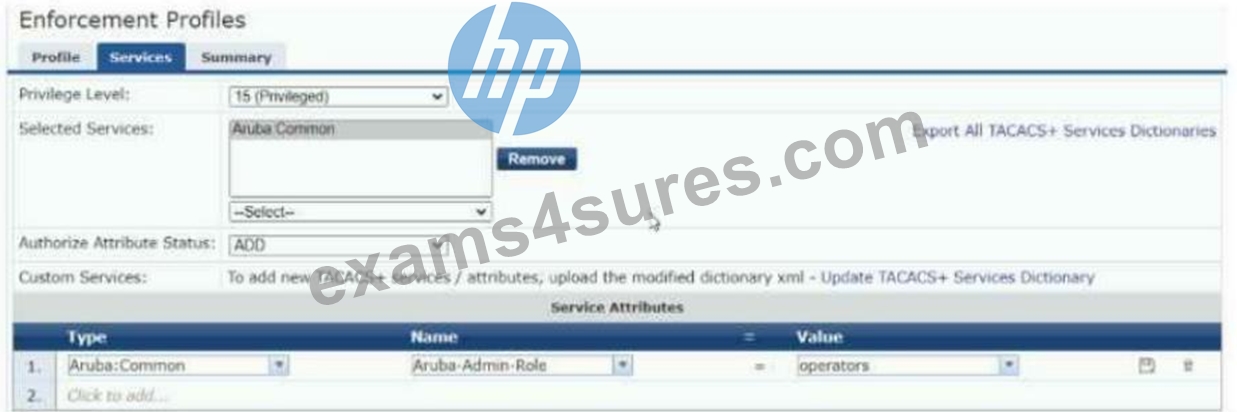
The exhibit shows the TACACS+ enforcement profile that HPE Aruba Networking ClearPass Policy Manager (CPPM) assigns to a manager. When this manager logs into an AOS-CX switch, what does the switch do?
- A. Assigns the manager operator-level privileges
- B. Rejects the manager with an error message
- C. Assigns the manager administrator-level privileges
- D. Assigns the manager auditor-level privileges
Answer: A
Explanation:
* TACACS+ Enforcement Profile:
* The profile specifies a Service Attribute under Aruba:Common with:
* Name: Aruba-Admin-Role
* Value: operators
* AOS-CX Role Mapping:
* On Aruba AOS-CX switches, the Aruba-Admin-Role attribute maps the authenticated user to predefined roles:
* operators: Operator-level privileges (read-only access, limited commands).
* administrators: Full administrator privileges.
* Other roles like auditors may exist based on configuration.
* Analysis:
* The value operators explicitly maps the user to operator-level privileges, granting read-only access to the AOS-CX switch.
* Since the Aruba-Admin-Role is correctly set and recognized, the switch assigns the appropriate role without errors.
* Option Breakdown:
* Option A: Correct. The switch assigns operator-level privileges based on the Aruba-Admin- Role value.
* Option B: Incorrect. Administrator-level privileges require the role value to be administrators.
* Option C: Incorrect. The manager is successfully authenticated and authorized; there is no error.
* Option D: Incorrect. There is no reference to an auditor role in the configuration shown.
Conclusion:
The operators value in the TACACS+ enforcement profile ensures that the manager is assigned operator- level privileges on the AOS-CX switch.
NEW QUESTION # 83
You have configured an AOS-CX switch to implement 802.1X on edge ports. Assume ports operate in the default auth-mode. VolP phones are assigned to the
"voice" role and need to send traffic that is tagged for VLAN 12.
Where should you configure VLAN 12?
- A. As the allowed trunk VLAN in the "voice" role (and not in the edge port settings)
- B. As the trunk native VLAN in the "voice" role (and not in the edge port settings)
- C. As the trunk native VLAN on edge ports and the trunk native VLAN on the "voice" role
- D. As a trunk allowed VLAN on edge ports and the trunk native VLAN in the "voice" role
Answer: A
Explanation:
When configuring 802.1X authentication on edge ports of an AOS-CX switch and assigning VoIP phones to a "voice" role, the correct approach is to configure VLAN 12 as the allowed trunk VLAN in the "voice" role.
This setup ensures that traffic tagged for VLAN 12 is appropriately managed by the role applied to the VoIP phones. In AOS-CX switches, the role-based VLAN configuration allows for more granular control and ensures that the VoIP phones' traffic is handled correctly without altering the edge port settings, which typically operate with default settings for authentication.
NEW QUESTION # 84
What is a use case for the HPE Aruba Networking ClearPass OnGuard dissolvable agent?
- A. Periodically scanning Linux clients for security issues
- B. Implementing a one-time compliance scan
- C. Auto-remediating posture issues on clients
- D. Continuously monitoring Windows domain clients for compliance
Answer: B
Explanation:
The use case for the HPE Aruba Networking ClearPass OnGuard dissolvable agent is implementing a one-time compliance scan. The dissolvable agent is designed to perform a compliance check without requiring a permanent installation on the client device. This is ideal for environments where a quick, temporary assessment of the device's security posture is needed without the overhead of a persistent agent.
1.Dissolvable Agent: The dissolvable agent is downloaded and executed on the client device for a single session, performing the necessary compliance checks before being removed automatically.
2.One-time Compliance Scan: This method is particularly useful for guest or unmanaged devices where a temporary compliance scan is sufficient to ensure security standards are met.
3.Minimal Impact: Since the agent does not persist on the client device, it minimizes the impact on the user's system and does not require ongoing maintenance or updates.
NEW QUESTION # 85
What is one use case that companies can fulfill using HPE Aruba Networking ClearPass Policy Manager's (CPPM's) Device Profiler?
- A. Assigning different AOS firewall roles to users on computers and the same users on smartphones
- B. Leveraging artificial intelligence to more accurately identify Internet of Things (loT) devices
- C. Quarantining devices that do not have the required antivirus software installed on them
- D. OIdentifying device security vulnerabilities by CVE ID and receiving remediation recommendations
Answer: B
Explanation:
One use case that companies can fulfill using HPE Aruba Networking ClearPass Policy Manager's (CPPM's) Device Profiler is leveraging artificial intelligence to more accurately identify Internet of Things (IoT) devices. ClearPass Device Profiler uses AI and machine learning to analyze network traffic and device behavior, providing detailed and accurate identification of IoT devices on thenetwork. This helps in managing and securing diverse and numerous IoT devices by ensuring they are correctly profiled and assigned appropriate access policies.
NEW QUESTION # 86
Refer to Exhibit.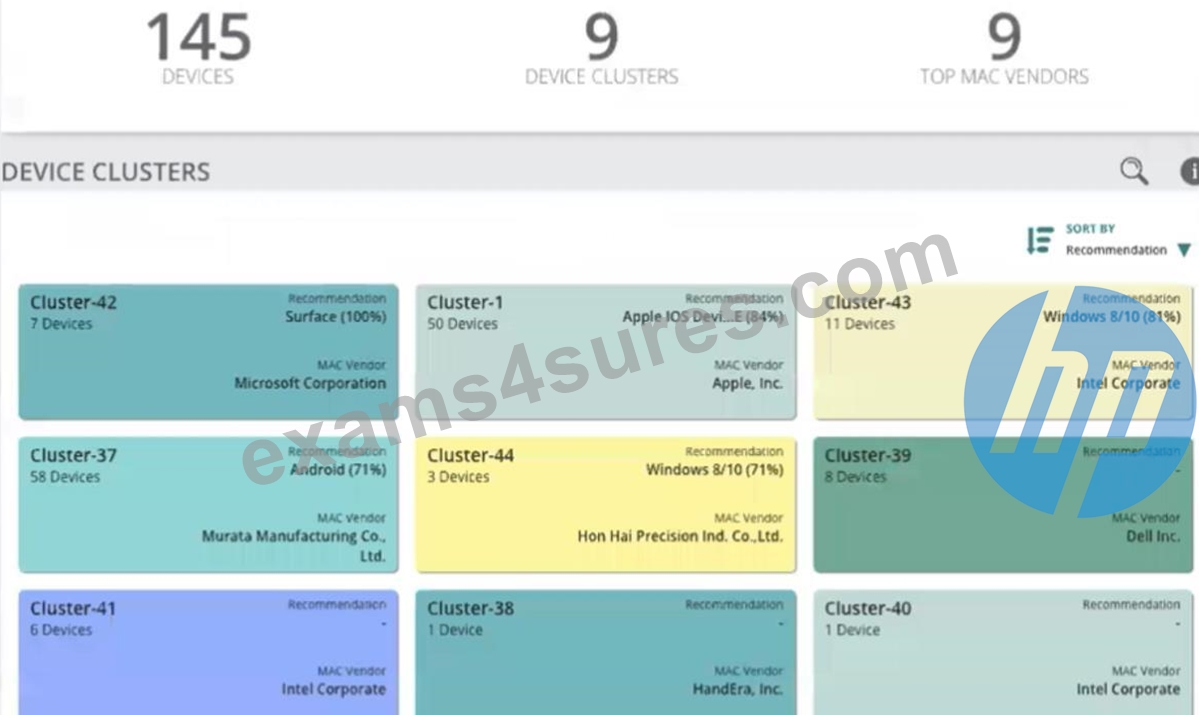
A company is using HPE Aruba Networking ClearPass Device Insight (CPDI) (the standalone application). In the CPDI interface, you go to the Generic Devices page and see the view shown in the exhibit.
What correctly describes what you see?
- A. Each cluster is a group of unclassified devices that CPDI's machine learning has discovered to have similar attributes.
- B. Each cluster is a group of devices that match one of the tags configured by admins.
- C. Each cluster is all the devices that have been assigned to the same category by one of CPDI's built-in system rules.
- D. Each cluster is a group of devices that have been classified with user rules, but for which CPDI offers different recommendations.
Answer: A
Explanation:
In HPE Aruba Networking ClearPass Device Insight (CPDI), the clusters shown in the exhibit represent groups of unclassified devices that CPDI's machine learning algorithms have identified as having similar attributes. These clusters are formed based on observed characteristics and behaviors of the devices, helping administrators to categorize and manage devices more effectively.
1.Machine Learning: CPDI uses machine learning to analyze device attributes and group them into clusters based on similarities.
2.Unclassified Devices: These clusters typically represent devices that have not yet been explicitly classified by admins but share common attributes that suggest they belong to the same category.
3.Management: This clustering helps in simplifying the process of managing and applying policies to groups of similar devices.
NEW QUESTION # 87
A company has HPE Aruba Networking APs running AOS-10 and managed by HPE Aruba Networking Central. The company also has AOS-CX switches. The security team wants you to capture traffic from a particular wireless client. You should capture this client's traffic over a 15 minute time period and then send the traffic to them in a PCAP file.
What should you do?
- A. Go to the client's AP in HPE Aruba Networking Central. Use the "Security" page to run a packet capture.
- B. Go to that client in HPE Aruba Networking Central. Use the "Live Events" page to run a packet capture.
- C. Access the CLI for the client's AP's switch. Set up a mirroring session between the AP's port and a management station running Wireshark.
- D. Access the CLI for the client's AP. Set up a mirroring session between its radio and a management station running Wireshark.
Answer: A
Explanation:
To capture traffic from a particular wireless client for a 15-minute period and then send the traffic in a PCAP file, you should go to the client's AP in HPE Aruba Networking Central and use the "Security" page to run a packet capture. This method allows you to directly capture the client's traffic from the AP managing the wireless connection, ensuring that you gather the relevant traffic data for analysis.
1.Centralized Management: HPE Aruba Networking Central provides a centralized interface for managing and monitoring APs, making it easy to initiate packet captures.
2.Security Page: The "Security" page in Aruba Central includes tools for running packet captures, allowing you to specify the duration and other parameters.
3.Ease of Use: This approach simplifies the process by using the built-in features of Aruba Central, avoiding the need for complex CLI commands or additional hardware.
NEW QUESTION # 88
A company has HPE Aruba Networking APs, which authenticate users to HPE Aruba Networking ClearPass Policy Manager (CPPM).
What does HPE Aruba Networking recommend as the preferred method for assigning clients to a role on the AOS firewall?
- A. Configure CPPM to assign the role using a RADIUS enforcement profile with an Aruba-User-Role VSA.
- B. Create user rules on the APs to assign clients to roles based on a variety of criteria.
- C. Configure CPPM to assign the role using a RADIUS enforcement profile with a RADIUS:IETF Username attribute.
- D. OCreate server rules on the APs to assign clients to roles based on RADIUS IETF attributes returned by CPPM.
Answer: A
Explanation:
The preferred method for assigning clients to a role on the AOS firewall is to configure HPE Aruba Networking ClearPass Policy Manager (CPPM) to assign the role using a RADIUS enforcement profile with an Aruba-User-Role VSA (Vendor-Specific Attribute). This method allows ClearPass to dynamically assign the appropriate user roles to clients during the authentication process, ensuring that role-based access policies are consistently enforced across the network.
Reference: Aruba ClearPass documentation and RADIUS configuration guides provide detailed instructions on setting up RADIUS enforcement profiles and using the Aruba-User-Role VSA for role assignment.
NEW QUESTION # 89
......
Sample Questions of HPE7-A02 Dumps With 100% Exam Passing Guarantee: https://www.exams4sures.com/HP/HPE7-A02-practice-exam-dumps.html
Correct Practice Tests of HPE7-A02 Dumps with Practice Exam: https://drive.google.com/open?id=1-NNL9WqBPKOoUG8oLPaDBeipjjXMcXOu