

Try AACE-PSP Free Now! Real Exam Question Answers Updated [Mar 27, 2026]
Get Ready to Pass the AACE-PSP exam with AACE International Latest Practice Exam
To be eligible for the AACE-PSP Certification Exam, candidates must meet certain requirements. They must have at least four years of professional experience in planning and scheduling, a bachelor's degree from an accredited institution or equivalent, and references from professional peers. Candidates who do not have a bachelor's degree may still be eligible if they have additional years of experience.
NEW QUESTION # 63
The EBS is established by:
- A. The government entity with the authority to approve/stop the work
- B. The contractors and subcontractors
- C. The entity with the authority to fund and direct the enterprise
- D. The contractor s planning and scheduling office
Answer: C
NEW QUESTION # 64
Using one crane capable of 30 lifts per day. for 3 column pours requiring 28 lifts each, plus assorted work in the area requiring an additional 150 lifts, what are the lowest planned workdays for this work?
- A. 3 workdays
- B. 18 workdays
- C. 7 workdays
- D. 8 workdays
Answer: D
NEW QUESTION # 65
Which of the following project planning situations is the most frequent contributor to cost overruns?
- A. lack of detailed planning for operational start-up
- B. Inadequate definition of scope at the estimate (budget) stage
- C. Inappropriate definition of work breakdown structure
- D. Insufficient planning for change management
Answer: B
Explanation:
* Impact of Scope Definition on Cost Overruns:
Poor scope definition leads to unrealistic budgets and unforeseen changes, which significantly contribute to cost overruns.
Other factors like change management and WBS definitions are secondary contributors compared to scope inadequacy.
* PSP Study Guide Reference:
The guide emphasizes scope definition as a critical factor for accurate budgeting and planning.
* Conclusion: The correct answer is D, as scope definition at the estimate stage has the most frequent and significant impact on cost overruns.
NEW QUESTION # 66
What activities are concurrent to Activity 2001 in the "normal" schedule?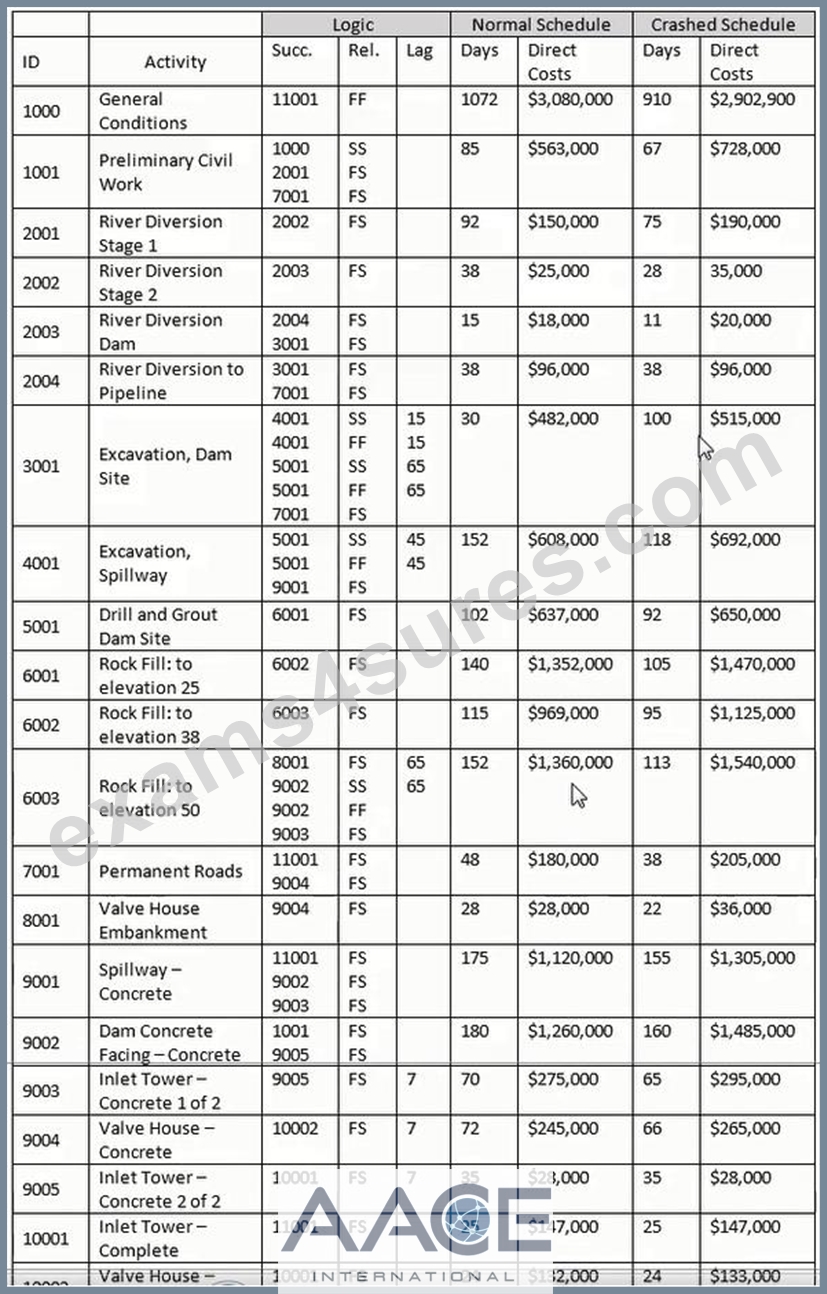
- A. 2003.
- B. 1000.
- C. 1001.
- D. 7001.
Answer: D
NEW QUESTION # 67
What method would be the best way to determine the most likely as-built critical path of a project that is underway, and the schedule of which has been partially progressed?
- A. Use the progressed portion of the critical path of the baseline schedule.
- B. Use the forward-looking critical path of the most current updates.
- C. Interview the project personnel for their perceptions and opinions because the schedule is usually inadequate.
- D. Use the progressed portion of the critical path of all the updates previous to the current update.
Answer: B
Explanation:
Understanding As-Built Critical Path Analysis:
Determining the as-built critical path of a project involves identifying the sequence of activities that actually dictated the completion of the project. This is especially important in projects that are underway, as schedules often deviate from the original baseline due to progress updates and unplanned changes.
Explanation of Each Option:
A). Use the progressed portion of the critical path of all the updates previous to the current update:
This is correct. To determine the most likely as-built critical path, analyzing the progressed portion of the critical path from all previous updates provides the most accurate representation of the project's actual execution. By reviewing the progression over time, you can piece together the actual sequence of critical activities.
B). Use the progressed portion of the critical path of the baseline schedule:
This is incorrect. The baseline schedule reflects the original plan, which may no longer be accurate due to progress deviations, delays, or changes in logic. Using the baseline alone does not account for the dynamic nature of the project.
C). Interview the project personnel for their perceptions and opinions because the schedule is usually inadequate:
This is incorrect. While project personnel may provide insights, relying solely on subjective opinions introduces biases and inconsistencies. A properly maintained and updated schedule is far more reliable for determining the critical path.
D). Use the forward-looking critical path of the most current updates:
This is incorrect. The forward-looking critical path only reflects what is expected to happen from the current point onward. It does not provide an accurate representation of the as-built critical path up to the current point.
* Study Guide Reference:
The PSP Study Guide emphasizes the importance of analyzing progress updates to trace the actual sequence of critical activities. Section 2.3.2 (Tracking Schedule Progress) discusses the role of historical updates in understanding project performance.
The guide also highlights that a proper as-built analysis requires a review of all updates to identify shifts in the critical path over time.
NEW QUESTION # 68
What is the relationship depicted between Activity G and Activity H?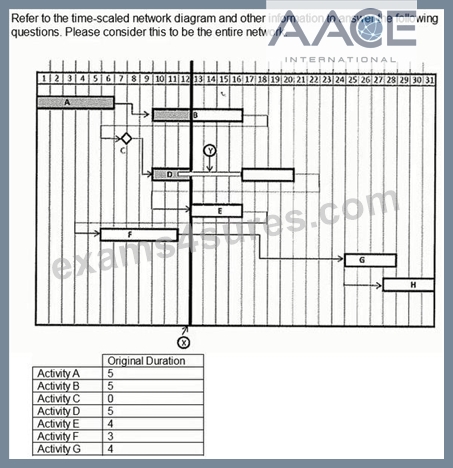
- A. Start-to-start.
- B. Finish-to-start.
- C. You cannot tell with the supplied information.
- D. Finish-to-finish.
Answer: A
NEW QUESTION # 69
If Activity A was delayed 5 days from starting, which of the following adjustments will NOT maintain the completion date of Activity C at Day 40?
- A. Replace the relationship from 'B' to 'C' with SSO
- B. Reduce the duration of 'A' from 20 days to 10 days and replace the relationship from B' to 'C with FSO.
- C. Reduce the duration of B" from 10 days to 5 days by compressing work effort
Answer: C
NEW QUESTION # 70
What problems can a soils engineer deal with on a project?
- A. Toxic soils.
- B. Survey error.
- C. Archeological findings.
- D. Hidden subsurface conditions.
Answer: D
Explanation:
* Role of Soils Engineer:
Soils engineers address subsurface conditions, such as soil stability, unexpected geology, and underground obstacles.
* Evaluation of Other Options:
A: Survey errors are typically addressed by surveyors.
C: Archeological findings involve specialists in historical preservation.
D: Toxic soils are typically handled by environmental engineers.
* Verification with PSP Guidelines:
The PSP Study Guide includes subsurface investigations as a key responsibility for geotechnical professionals (Ref: PSP Study Guide, Chapter 1A: Site Conditions).
NEW QUESTION # 71
These are the activities on the critical path:
- A. A, D, & I.
- B. A, B, G, & H.
- C. A, C, E, & H.
- D. A, B, F, & J
Answer: B
Explanation:
* Critical Path Identification:
The critical path is the longest sequence of activities that determines the project's minimum duration.
Path: A → B → G → H.
* Exclusion of Other Options:
Paths involving F, J, or non-critical activities do not align with the longest duration.
* Verification with PSP Guidelines:
The PSP Study Guide emphasizes identifying the critical path for schedule optimization (Ref: PSP Study Guide, Chapter 2A: Critical Path Analysis)
NEW QUESTION # 72
What was the original planned duration for Activity A through Activity G?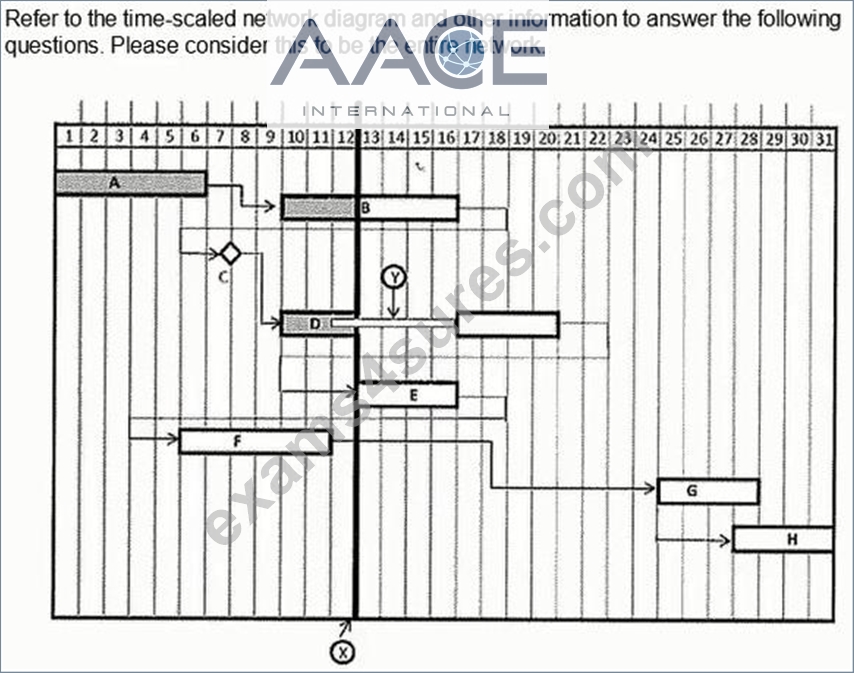
- A. 24.
- B. 25.
- C. 26.
- D. 28.
Answer: D
NEW QUESTION # 73
If Activity A was delayed 5 days from starting, which of the following adjustments will NOT maintain the completion date of Activity C at Day 40?
- A. Reduce the duration of 'A' from 20 days to 10 days and replace the relationship from B' to 'C with FSO.
- B. Reduce the duration of B" from 10 days to 5 days by compressing work effort
- C. Replace the relationship from 'B' to 'C' with SSO
Answer: A
Explanation:
* Understanding the Problem Context:
Activity C is currently set to complete on Day 40.
Activity A has a 5-day delay in starting, so adjustments are needed to maintain the Day 40 completion date for Activity C.
The key is to identify which adjustment will fail to maintain the timeline.
* Option-by-Option Analysis:
A . Reduce the duration of 'A' from 20 days to 10 days and replace the relationship from 'B' to 'C' with FSO (Finish-to-Start with Offset):
Reducing Activity A's duration from 20 to 10 days might mitigate part of the delay, but replacing the relationship between B and C with FSO introduces an offset.
FSO relationships typically delay the start of successor activities (Activity C in this case).
This would likely push Activity C beyond Day 40 because the delay in B's finish, coupled with the offset, would result in C starting later.
This adjustment does NOT maintain the completion date of Activity C.
B . Replace the relationship from 'B' to 'C' with SSO (Start-to-Start with Offset):
An SSO relationship allows Activity C to begin once Activity B starts (with or without an offset).
This adjustment effectively overlaps the schedules of B and C, mitigating delays from A.
This adjustment can maintain the completion date of Activity C at Day 40.
C . Reduce the duration of 'B' from 10 days to 5 days by compressing work effort:
Reducing B's duration by compressing its schedule shortens its timeline, allowing Activity C to start sooner.
This adjustment offsets the delay caused by Activity A.
This adjustment can maintain the completion date of Activity C at Day 40.
* Final Answer and Justification:
The adjustment described in A will NOT maintain the completion date of Activity C at Day 40 because the FSO relationship introduces delays, making it ineffective in this scenario.
Options B and C offer feasible adjustments to maintain the timeline.
* Study Guide Reference:
Refer to the PSP Certification Study Guide, Chapter 2 - Scheduling, Subchapter 2.2.4: Relationships (p. 151-157), which details the impact of logical relationships (FSO, SSO) on schedule timelines.
Additionally, review AACE Recommended Practice 52R-06: Time Impact Analysis for insights into how delays affect dependent activities and methods for mitigating them.
NEW QUESTION # 74
When are project planning and scheduling specifications established?
- A. During the bidding process
- B. After the bid price is accepted
- C. Before me NTP
- D. Before the tendering documents are finalized
Answer: D
NEW QUESTION # 75
Which of the following is NOT required when performing weekly or monthly schedule updates?
- A. Percent complete.
- B. Original duration of activities.
- C. Remaining duration of activities.
- D. Actual finish of activities.
Answer: B
Explanation:
* Update Process Essentials:
Schedule updates track the current status of the project using actuals (start/finish dates), progress (percent complete), and future plans (remaining duration).
The original duration does not change and is part of baseline data, not required for routine updates.
* PSP Study Guide Reference:
Scheduling update procedures are discussed, emphasizing active progress tracking elements like actual start, percent complete, and remaining duration.
* Conclusion: The correct answer is D, as original duration is not a variable considered in regular updates.
NEW QUESTION # 76
Which letter of the alphabet best approximates the graphical shape of a project's cumulative cost baseline, or budgeted cost of work scheduled?
- A. B.
- B. C.
- C. W.
- D. S.
Answer: D
Explanation:
The cumulative cost baseline typically forms an "S" curve, reflecting slow initial expenditures, accelerating progress during peak activities, and tapering off as the project concludes.
Option A, B, and D do not represent the characteristic shape of a project's cost curve.
The PSP Study Guide highlights the "S" curve as a standard graphical representation of cumulative project costs over time.
NEW QUESTION # 77
Which of the following options is NOT a feasible method to reduce the overall completion time of the toll road program?
- A. Allocating forces from other BILCO contracts to the toll road project
- B. Proceeding with the work in advance of the environmental studies
- C. Subcontract outside forces to accelerate the Phase A Schedule
- D. Reduce the phasing from 5 phases to 3 phases
Answer: B
NEW QUESTION # 78
Identify the late finish to develop plans and specs.
- A. 8 months.
- B. 7 months.
- C. 10 months.
- D. 9 months.
Answer: C
Explanation:
* Late Finish Analysis for Activity C (Develop Plans and Specs):
Activity C duration is 5 months, starting after Activity A (3 months).
Late finish = Early start of successor (Activity E) = 10 months.
* Cross-Verification:
Based on backward pass calculations, Activity C must end by month 10 to not delay its successor.
* Verification with PSP Guidelines:
Late finish values are calculated during backward pass (Ref: PSP Study Guide, Chapter 2A: Backward Pass and Float Calculations).
NEW QUESTION # 79
The linear scheduling velocity diagram has the following two-axis:
- A. Time and crew size
- B. Location and crew size
- C. Time and location
- D. Time and rate of progress
Answer: C
Explanation:
The linear scheduling velocity diagram uses time on one axis and location on the other. This graphically represents the progression of work at various locations over time.
Option C (time and rate of progress) and Option D (time and crew size) refer to related concepts but do not accurately describe the axes.
Option A (location and crew size) is unrelated.
This aligns with graphical techniques discussed for construction scheduling.
NEW QUESTION # 80
Which of the following is NOT true?
- A. Constraints can interfere with the longest path calculation.
- B. Multiple calendars can affect the total float calculation.
- C. A network must contain only one Critical Path.
- D. Remaining durations can exceed original durations.
Answer: D
NEW QUESTION # 81
What is the remaining work duration of Active D?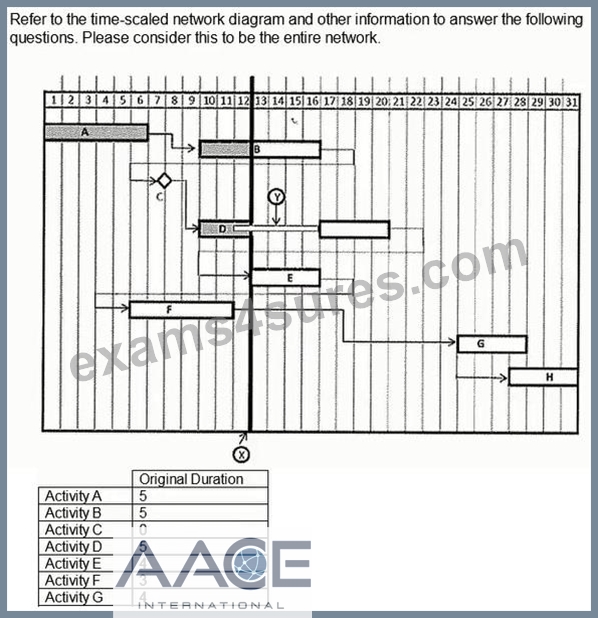
- A. 4.
- B. 3.
- C. 0
- D. 8.
Answer: A
NEW QUESTION # 82
......
Pass Your Next AACE-PSP Certification Exam Easily & Hassle Free: https://www.exams4sures.com/AACE-International/AACE-PSP-practice-exam-dumps.html
Get Prepared for Your AACE-PSP Exam With Actual AACE International Study Guide!: https://drive.google.com/open?id=1X56IFkjUpgaV4Ell4Rj38l4F3WSQ5Zgz