

Use 3V0-21.25 Exam Dumps (2026 PDF Dumps) To Have Reliable 3V0-21.25 Test Engine
3V0-21.25 PDF Recently Updated Questions Dumps to Improve Exam Score
NEW QUESTION # 37
An administrator must initiate the deployment of a new 3-tier application architecture using the VMware Cloud Foundation (VCF) Automation portal. This application includes:
* A web tier (stateless).
* A business logic tier (some local caching).
* A database tier (stateful, PostgreSQL).
* An NSX load balancer fronting the web tier.
* ~99.9% uptime requirement.
* Moderate performance requirements.
Which requirement represents a risk inherent to single-zone deployments?
- A. A split-brain isolation.
- B. A higher network complexity.
- C. A shared failure domain for all application tiers.
- D. A higher latency between application tiers.
Answer: C
Explanation:
The primary architectural risk in any single-zone deployment within VCF 9.0 is the existence of a shared failure domain. In a single-zone Supervisor cluster or workload domain, all components-including the web, application, and database tiers-reside within the same logical and often physical infrastructure boundary (such as a single rack or data center room). If the underlying zone experiences a critical failure, such as a localized power outage, cooling failure, or a total top-of-rack switch collapse, the entire 3-tier application stack will go offline simultaneously. For mission-critical applications requiring high availability, VCF 9.0 recommends a multi-zone or stretched cluster architecture. In such designs, the failure of one zone does not compromise the entire application because the tiers can be distributed across different fault domains, ensuring that the stateless web tier and stateful database remain operational elsewhere. In the context of the 99.9% uptime requirement mentioned, a single-zone design represents a significant risk because it lacks the redundancy needed to survive zone-level disruptions.
NEW QUESTION # 38
A system administrator is tasked to create a region for use within an AIIApps organization. How would the administrator determine which vCenter Servers are available in the infrastructure?
- A. Verify connections in the Organization portal.
- B. Manually look up the UUID of the vCenter Server(s) in the VMware Kubernetes Service (VKS).
- C. Verify connections in the Provider Management portal.
- D. Manually look up the UUID of the vCenter Server(s) in the vSphere Client.
Answer: C
Explanation:
The Provider Management Portal in VCF 9.0 is the centralized interface where the cloud provider administrator manages all foundational infrastructure. When creating a Region, the administrator must select from the infrastructure already integrated into the VCF Automation appliance. By navigating to the infrastructure or "Cloud Accounts" section within the Provider Management Portal, the administrator can see the status of all vCenter Server and NSX Manager connections. This portal provides the "provider-view" of the entire fleet, allowing the admin to verify which vCenter instances are currently healthy, licensed for VCF 9.0, and have the Supervisor enabled. This step is critical because a Region cannot be successfully created if the underlying vCenter connection is down or the integration is incomplete. The Organization Portal, by contrast, is a tenant-facing interface and does not have the visibility into the global infrastructure required to perform these "Day 0" provider setup tasks.
NEW QUESTION # 39
An administrator has been tasked with configuring tenant branding with the following requirements:
* Organization branding should only appear when a user has logged in to the organization portal.
Select the three steps involved in configuring branding. (Choose three.)
- A. Navigate to Branding.
- B. Disable the Enable Login and Logout Page Branding setting.
- C. Log into the Provider Management Portal.
- D. Import a branding theme.
- E. Enable the Enable Login and Logout Page Branding setting.
- F. Log into the Organization Portal.
Answer: A,B,F
Explanation:
In VMware Cloud Foundation 9.0, branding is managed within the Organization Portal to allow for tenant- specific customization. To meet the specific requirement that branding only appears after a user has authenticated, the administrator must navigate to the Branding section of the portal. The critical configuration step is to Disable the Enable Login and Logout Page Branding setting. By default, if this is enabled, the custom logos and colors are displayed on the public-facing login screen. Disabling it ensures that the generic VCF/Broadcom login page is presented to the public, and the custom tenant identity is only loaded into the browser session once the user's organization context is established through successful login. This is a common requirement for service providers who want to maintain a consistent entry point for all users while providing a personalized "white-labeled" experience once the user is inside their specific environment.
NEW QUESTION # 40
A vSphere administrator has created a new vSphere storage policy, labeled Gold Tier, mapped to some new NVMe-backed datastores.
The VMware Cloud Foundation (VCF) Automation administrator is tasked to permit access to this new storage type for consumers of a PerformanceTest Project in an AIIApps organization named Engineering.
What must be done within VCFA to accomplish the task?
- A. Add the Storage Class backed by the Gold Tier storage policy to a Supervisor Namespace Class and bind that Namespace Class to the PerformanceTest Project.
- B. Create a new Zone in VCF Automation, select the Gold Tier vSphere storage policy, and assign the Zone to the PerformanceTest Project.
- C. Configure a Day-2 policy on the PerformanceTest project to enforce Gold Tier as the preferred storage.
- D. Create a new VMApps Organization for Engineering and ensure the Gold Tier vSphere storage policy is selected for new projects.
Answer: A
Explanation:
In an AllApps (AIIApps) organization, resource entitlement follows the Supervisor-native path. To provide access to the "Gold Tier" storage, the VCF Automation administrator must first ensure the vSphere storage policy is recognized as a Storage Class by the Supervisor. The correct operational step is to Add the Storage Class backed by the Gold Tier policy to a Supervisor Namespace Class. The Namespace Class acts as the policy engine that governs what resources are "allow-listed" for the tenant. Once the Namespace Class is configured with the Gold Tier storage class, the administrator must bind that Namespace Class to the PerformanceTest Project. This makes the high-performance NVMe storage visible and available for use by the users within that specific project, allowing them to select it when deploying stateful applications or persistent volumes, without affecting other projects or organizations.
NEW QUESTION # 41
An Organization Administrator for an AIIApps Organization in VMware Cloud Foundation (VCF) Automation must determine which networks are used by deployed workloads.
How does the administrator view the networks?
- A. The NSX segments mapped to each workload are visible by expanding deployment details for each deployed workload in the Organization Portal.
- B. VPCs, connectivity profiles and the associated NSX segment and Tier-1 gateway details can be retrieved with vcf-cli deployment get.
- C. VPCs and connectivity profile assignments are visible in the Organization Portal, but the underlying NSX Tier-1 gateways and segments are not.
- D. The NSX Tier-1 gateway mappings for each workload in the Organization can be retrieved with kubectl get vm.
Answer: C
Explanation:
The AllApps (AIIApps) organization model in VCF 9.0 is built on the principle of high-level abstraction to simplify the developer experience. In this model, the Organization Portal presents networking through the lens of Virtual Private Clouds (VPCs) and Connectivity Profiles. The Organization Administrator can easily view which VPC a workload belongs to and what connectivity policies (such as public access or isolation) are applied. However, the underlying NSX implementation details-such as the specific Tier-1 gateways and segments automatically created by the Supervisor-are intentionally abstracted away from the organization-level view. This "cloud-style" visibility ensures that tenants can manage their application networking without being burdened by the complexity of the provider's physical or logical NSX fabric, which remains the exclusive domain of the Provider Administrator.
NEW QUESTION # 42
An administrator is responsible for managing a VMware Cloud Foundation (VCF) fleet and the administrator has been tasked with the following:
* Create DNS records before each virtual machine (VM) is deployed using VCF Automation.
The administrator has already completed the following tasks:
* Created two VCF Operations Orchestrator Workflows with corresponding Event Subscriptions:
* Create DNS Record
* Delete DNS Record
* Created a new blueprint to deploy a VM:
* Added two string inputs, hostname and domainName
* Added hostname: '${input.hostname}' as a custom property of the Virtual Machine resource.
* Added domainName: '${input.domainName}' as a custom property of the Virtual Machine resource.
What should the administrator configure within the Event subscription to ensure that the DNS record is only created when the hostname is provided?
- A. Add the Delete DNS Record workflow as the Recovery Workflow of the Create DNS Record subscription.
- B. Enable the Block execution of events in topic option in the Create DNS Record and Delete DNS Record subscriptions.
- C. Add the event.data.customproperties['hostname'] != null condition to the Create DNS Record and Delete DNS Record subscriptions.
- D. Add the event.data.customproperties['domainName'] != null condition to the Create DNS Record and Delete DNS Record subscriptions.
Answer: C
Explanation:
VCF Automation 9.0 utilizes an Event Broker Service (EBS) to trigger extensibility workflows during the lifecycle of a deployment. For a DNS integration to function correctly and reliably, the event subscription must be "scoped" to prevent it from firing when essential metadata is missing. In this scenario, the administrator has mapped the user input hostname to a custom property of the virtual machine. By adding the condition event.data.customproperties['hostname'] != null to the subscription, the platform evaluates the payload before invoking the Operations Orchestrator workflow. If the consumer leaves the hostname field empty (assuming it is not marked as mandatory in the blueprint), the condition will evaluate to false, and the DNS creation workflow will not be triggered, preventing "empty" or invalid records from being sent to the DNS provider. This logic must be applied to both the creation and deletion subscriptions to maintain parity throughout the VM's lifecycle. Using the customproperties array within the event.data payload is the standard method for referencing blueprint-specific inputs within the VCF 9.0 extensibility framework.
NEW QUESTION # 43
An organization requires a solution that provides a "Google Cloud-like" consumption model for their on- premises infrastructure. They need to provide developers with a single portal where they can request:
* Virtual Machines (Windows and Linux).
* Tanzu Kubernetes Grid (TKG) clusters.
* S3-compatible Object Storage.
* Managed Database Services.
Which VCF 9.0 capability directly addresses this requirement?
- A. VMApps Organizations
- B. NSX VPC isolation
- C. VCF Operations dashboarding
- D. AllApps Organizations leveraging Supervisor Services
Answer: D
Explanation:
The AllApps Organization in VCF 9.0 is specifically engineered to provide the "cloud-native" consumption experience required by modern development teams. While traditional VM management is handled by VMApps, the AllApps model unlocks the full potential of the vSphere Supervisor. By leveraging Supervisor Services, the organization can present a catalog that goes far beyond simple IaaS. Developers can provision not only VMs and TKG clusters but also higher-level services like vSAN Data Persistence platform for S3-compatible storage and managed databases (e.g., PostgreSQL or MySQL) through integrated operators. This architecture abstracts the underlying vSphere and NSX complexity, presenting the developer with a unified API and UI for multi-cloud-style resource consumption, directly fulfilling the goal of providing a public-cloud-like experience within the on-premises data center.
NEW QUESTION # 44
Click on the area to find syntax assistance to include a cloudConfig stanza to the blueprint.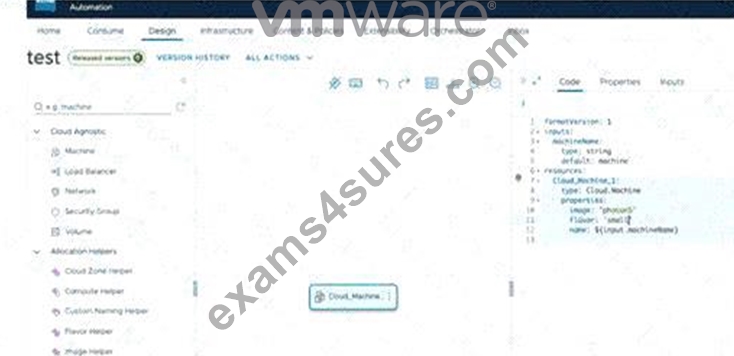
Answer:
Explanation: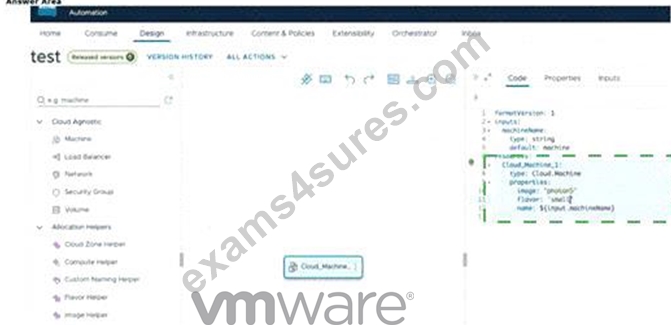
Explanation:
Click on the "Machine" resource under the "Cloud Agnostic" category in the left-side resource palette.
In the VCF 9.0 Automation Design Canvas, the platform provides built-in schema documentation and syntax assistance to help administrators build valid YAML blueprints. To find specific guidance for the cloudConfig stanza-which is used to pass cloud-init or post-provisioning scripts to a guest OS-the administrator should use the resource palette on the left side of the screen.
By clicking on the "Machine" resource (typically found under the Cloud Agnostic category), the interface displays a context-sensitive help pane or schema view. This pane lists all available properties for the Cloud.Machine resource type, including detailed descriptions and examples for cloudConfig.
This documentation is essential because cloudConfig requires specific YAML indentation and key- value pairings (such as users: or runcmd:) to be correctly interpreted by the cloud-init agent within the virtual machine. This integrated "just-in-time" assistance ensures that administrators can quickly reference the correct syntax without leaving the design environment, reducing errors in complex multi- cloud template development.
NEW QUESTION # 45
A customer needs to deploy Kubernetes-based workloads in a newly created VMware Cloud Foundation (VCF) workload domain.
Which two prerequisites must be met before creating an AllApps Organization in VMware Cloud Foundation (VCF) Automation? (Choose two.)
- A. The VCF workload domain must be configured for VMware NSX Federation.
- B. Supervisor must be activated within the VCF workload domain.
- C. A Region must be configured within the VCF Automation Provider Management Portal.
- D. Supervisor must be activated within the VCF Management domain and workload domain.
- E. The VMware Kubernetes Service (VKS) must be activated within the VCF Management domain.
Answer: B,C
Explanation:
To support an AllApps Organization, which is inherently designed for both Kubernetes and VM workloads, the underlying infrastructure must be "modernized" via the vSphere Supervisor. Activating the Supervisor within the specific Workload Domain is the primary prerequisite, as it transforms the standard vSphere clusters into a Kubernetes-native control plane. Once the hardware/vSphere layer is ready, the next mandatory step takes place within the VCF Automation Provider Management Portal, where the administrator must define a Region. The Region acts as the "bridge" between the physical workload domain and the logical Organization; it discovers the Supervisor clusters and makes their compute, memory, and storage classes available for tenant assignment. Without a defined Region, the AllApps Organization has no source of resources to consume, and without an active Supervisor, the AllApps networking (VPC) and container services (VKS) cannot function.
NEW QUESTION # 46
An administrator is tasked to implement a GitOps workflow to manage VMware Cloud Foundation (VCF) Automation blueprints and infrastructure deployment.
Which statement describes VCF Automation support for this use case?
- A. Provides version synchronization from a Git repository, enabling declarative infrastructure management and version control.
- B. Supports continuous monitoring of Git repositories and automatic application of changes to running deployments.
- C. Supports export of YAML descriptions of deployed infrastructure and committing the results back to a Git repository for drift detection and rollback.
- D. Provides native management of ArgoCD instances, GitOps pipelines, and triggering of GitOps deployments directly from the VCFA UI.
Answer: A
Explanation:
VCF 9.0 Automation natively supports GitOps methodologies by providing version synchronization with Git-based repositories (such as GitHub, GitLab, or Bitbucket). This integration allows administrators and developers to treat infrastructure as code (IaC) by storing blueprints (Cloud Templates) as YAML files in a version-controlled environment. The platform can be configured to periodically sync with the repository, ensuring that the latest "released" versions in Git are automatically available in the VCF Automation service catalog. This enables a declarative management model where changes to infrastructure are proposed via Pull Requests, peer-reviewed, and then synchronized to the private cloud environment. While it facilitates the lifecycle of the templates, it is primarily a synchronization engine (Option A) rather than a full-scale CD tool like ArgoCD or a real-time "auto-apply" engine for running instances, providing the necessary balance between developer flexibility and operational governance.
NEW QUESTION # 47
A company has deployed an new VMware Cloud Foundation (VCF) Fleet within their development environment. An administrator has been tasked with configuring the organization for VM Apps so that developers can start to create new cloud templates and catalog items.
When creating the organization for VM Apps, the administrator successfully configured access control and assigned Organization-level and Service-level roles to the correct users and groups.
Drag and drop the five steps the administrator must take from the Steps list into the Ordered Steps list and place them in the correct order so that the objective is completed.
(Choose five.)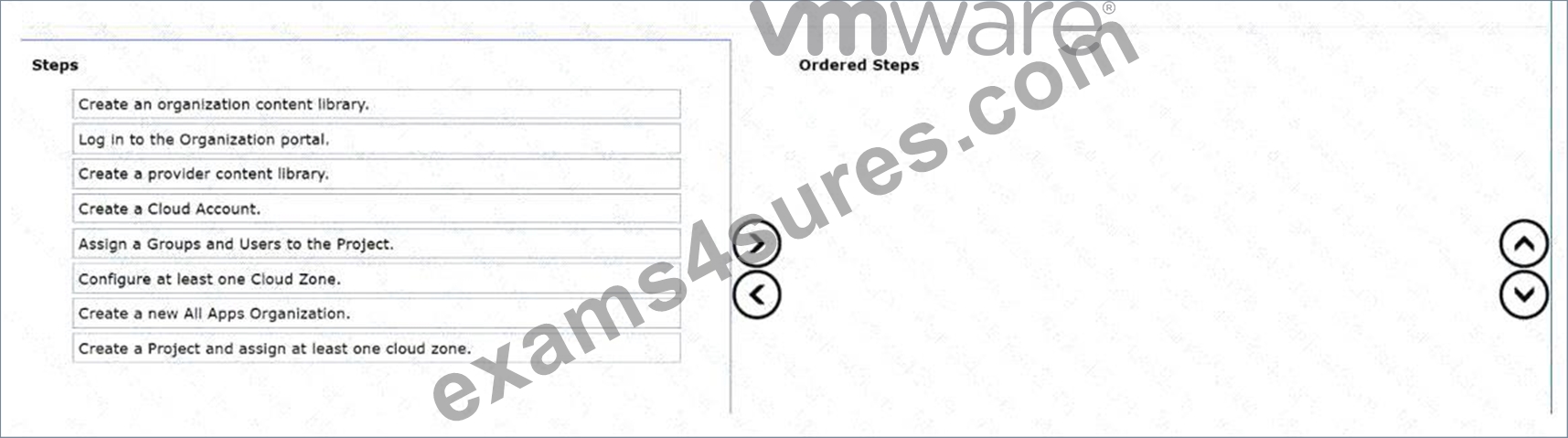
Answer:
Explanation: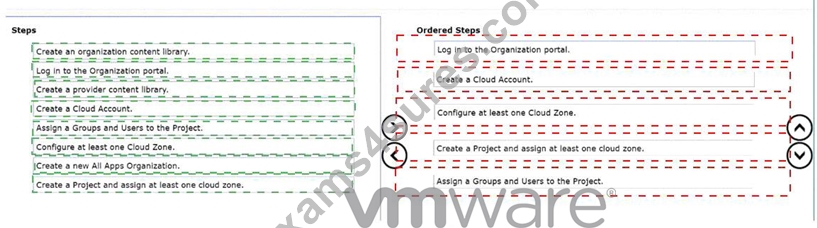
Explanation:
VM Apps Organization Configuration
Verified answer:
* Log in to the Organization portal.
* Create a Cloud Account.
* Configure at least one Cloud Zone.
* Create a Project and assign at least one cloud zone.
* Assign a Groups and Users to the Project.
In VMware Cloud Foundation (VCF) 9.0, configuring a VMApps Organization for developer self-service follows a specific hierarchical workflow once the initial organization creation and role assignments are complete. The administrator must first Log in to the Organization portal to perform tenant-specific resource management.
The first technical requirement is to establish a connection to the underlying infrastructure by choosing to Create a Cloud Account. This account integrates the tenant's view with the vCenter and NSX Manager resources provided by the fleet administrator. Once connectivity is established, the admin must Configure at least one Cloud Zone. In the VMApps model, the Cloud Zone is the construct that defines which compute clusters, storage policies, and networks are available for workload placement.
To enable consumption, the administrator must Create a Project and assign at least one cloud zone.
The Project serves as the primary governance boundary where resource quotas and cloud templates are managed. Finally, the administrator must Assign Groups and Users to the Project. This entitlement step ensures that developers have the necessary permissions (e.g., Project Administrator or Member) to consume the infrastructure and create the required catalog items within their isolated environment.
NEW QUESTION # 48
Which statement describes Virtual Private Clouds (VPCs)?
- A. Enables multiple organizations to share virtualized GPUs.
- B. Enables the provider administrator to create multiple VCF instances nested within public clouds (e.g., Amazon AWS, Microsoft Azure, Google GCP, etc.).
- C. Enables multiple organizations to share the same physical Supervisor cluster while consuming logically isolated networks.
- D. Enables the provider administrator to create nested VCF instances with a private cloud.
Answer: C
Explanation:
Virtual Private Clouds (VPCs) in VCF 9.0 represent a significant evolution in multi-tenant networking. A VPC is a logically isolated network partition that exists within a shared physical infrastructure, specifically a Supervisor cluster. This construct allows multiple distinct organizations to coexist on the same compute hardware while maintaining complete separation of their network traffic, IP address spaces, and security policies. Each VPC acts as a "mini-datacenter" for the tenant, providing automated services such as routing, DHCP, NAT, and distributed firewalls without the tenant ever needing to see or interact with the underlying NSX Tier-0 or Tier-1 gateway architecture. This "abstraction" is the key to scaling VCF 9.0 deployments, as it allows the provider to maximize host utilization across many small tenants while giving each tenant the
"look and feel" of a dedicated, private networking environment. It effectively removes the complexity of manual VLAN or segment management that characterized older private cloud architectures.
NEW QUESTION # 49
What are two prerequisites to enable provisioning VMs via kubectl against tenant resources? (Choose two.)
- A. Generate an API token from the VCF Automation UI.
- B. Create a new extensibility Action.
- C. Create a context via VCF CLI.
- D. Ask the Provider to generate a token via the system APIs.
- E. Create a context via kubectl.
Answer: A,C
Explanation:
In VCF 9.0, the AllApps (AIIApps) organization model allows users to interact with infrastructure using Kubernetes-native tools like kubectl. To establish this connection, the user must first Generate an API token from the VCF Automation UI. This token provides the necessary authentication context for the specific organization and project the user belongs to. Once the token is obtained, the user must use the VCF CLI (vcf- cli) to create a context. The VCF CLI is the specialized tool that bridges the gap between the VCF Automation API and the local kubeconfig file. By running the login command within the VCF CLI, a specialized context is injected into the user's kubectl configuration, mapping the local environment to the remote Supervisor Namespace and its associated VPC resources. This allows developers to use standard kubectl apply commands to provision virtual machines and other resources directly into their assigned tenant space.
NEW QUESTION # 50
The organization administrator is tasked with entering a range of IP addresses available for inter-VPC communication. Into which field does the organization administrator need to enter the IP addresses?
- A. External IP Blocks.
- B. Default Outbound NAT.
- C. N-S Ingress QoS Profile.
- D. Private-Transit Gateway IP Blocks.
Answer: D
Explanation:
In the VCF 9.0 multi-tenant networking model, Virtual Private Clouds (VPCs) communicate with each other through a regional backbone. The Private-Transit Gateway IP Blocks field is specifically designated for the internal IP ranges used to facilitate this inter-VPC connectivity. When an administrator configures a Connectivity Profile for an organization, they must define these blocks to ensure that traffic routed between different departments or projects within the same region has a valid, non-conflicting address space to traverse the NSX Transit Gateway. Unlike External IP Blocks, which are used for SNAT/DNAT to the public internet or corporate WAN, the Private-Transit blocks are strictly for the "east-west" transit layer within the VCF Automation framework. Proper allocation in this field is essential for enabling seamless microservices communication across VPC boundaries while maintaining the logical isolation provided by the Supervisor.
NEW QUESTION # 51
Which service provides the ability to backup and restore vSphere pods?
- A. Velero
- B. VM Service
- C. ArgoCD
- D. Contour
- E. VKS
Answer: A
Explanation:
Velero is the industry-standard and VMware-supported service integrated into VCF 9.0 for the backup and restoration of Kubernetes-based workloads, specifically vSphere Pods and persistent volumes. Within the VCF Automation framework, Velero is often deployed as part of the Supervisor services or within TKG clusters to provide data protection for stateful applications. It captures the state of the Kubernetes API objects (such as Pod specs and Secrets) and triggers snapshots of the underlying vSphere storage (via the Cloud Native Storage/CNS driver) to ensure that workloads can be recovered in the event of a cluster failure or accidental deletion. While other services like ArgoCD handle continuous delivery and VKS handles cluster lifecycle, only Velero is dedicated to the operational task of disaster recovery and migration of containerized resources within the vSphere Supervisor environment.
NEW QUESTION # 52
Match the VMware Cloud Foundation (VCF) Operations orchestrator component with its description by dragging and dropping the correct item from the Component list on the left and place them onto the Description list on the right.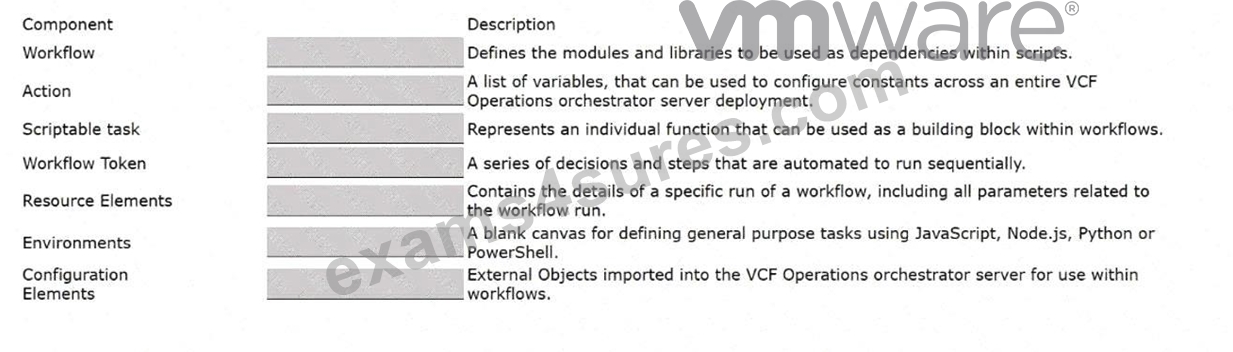
Answer:
Explanation: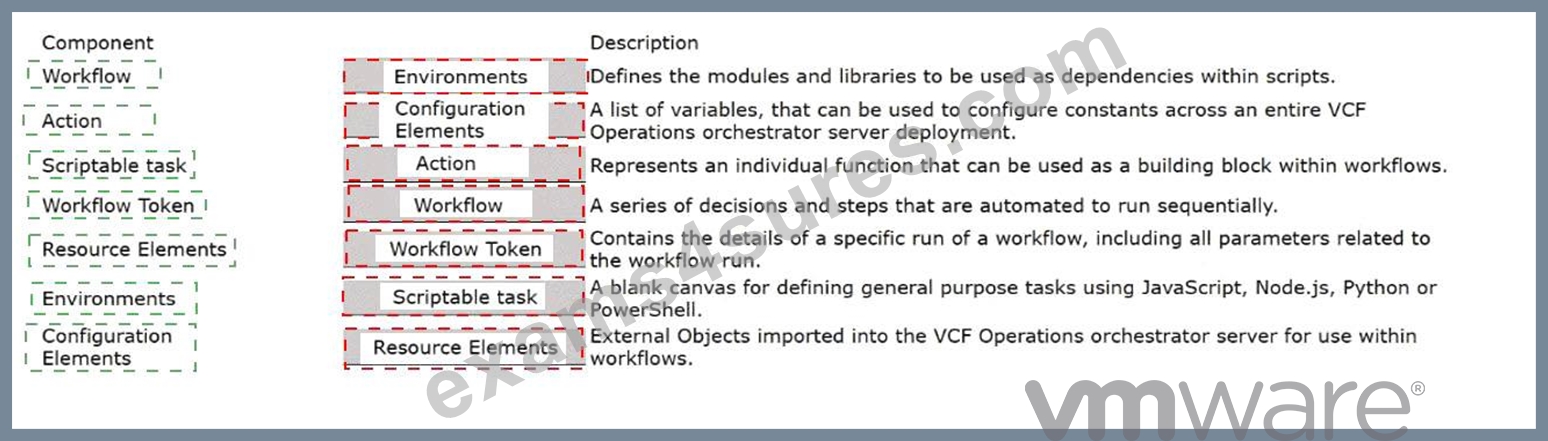
Explanation: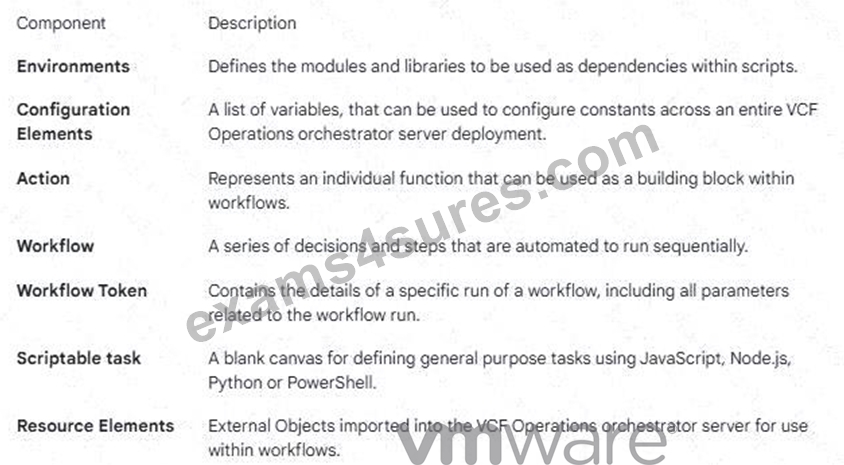
In VMware Cloud Foundation 9.0, the VCF Operations orchestrator (formerly vRealize Orchestrator) utilizes a specific object-oriented hierarchy to facilitate infrastructure automation. Workflows are the primary administrative unit, representing a logical sequence of automated steps. Within these, Actions serve as reusable, modular functions-often written in JavaScript-that act as building blocks across multiple workflows to reduce code duplication. For custom logic, Scriptable tasks provide a "blank canvas" allowing developers to execute polyglot scripts (Node.js, Python, or PowerShell) directly within a workflow's schema.
To manage environment-wide variables and reusable assets, the orchestrator uses Configuration Elements and Resource Elements. Configuration Elements store persistent constants (like API endpoints or global timeout values) shared across the server, while Resource Elements allow the import of external files (such as XML, text, or binary files) for use during execution. Modern scripting requirements are handled by Environments, which define the specific runtime dependencies and external libraries (like boto3 for Python) needed for complex integrations. Finally, the Workflow Token is a critical operational object created during every execution; it stores the specific state, inputs, and outputs of a single run, serving as the primary source for audit trails and troubleshooting failed automation tasks. Together, these components allow for the deep extensibility required to integrate VCF with third-party ITSM and CMDB platforms.
NEW QUESTION # 53
A customer requires a backup of blueprints within VMware Cloud Foundation (VCF) Automation to a third- party solution each time the blueprint is released.
What construct will satisfy the requirement?
- A. Event broker subscription
- B. ArgoCD service
- C. CloudConfig
- D. Velero service
Answer: A
Explanation:
To automate the export or backup of Blueprints (Cloud Templates) in VCF 9.0, the Event Broker Service (EBS) is the required mechanism. While Velero (Option A) is used for backing up vSphere Pods and ArgoCD (Option C) is for continuous delivery, neither is designed to "listen" for internal automation metadata changes.
By creating an Event Broker Subscription mapped to the "Blueprint Released" or "Template Version Created" topic, the administrator can trigger an action every time a developer finalizes a new version of their infrastructure code. This triggered action (typically an ABX or Orchestrator task) can then programmatically retrieve the YAML definition of the blueprint via the VCF Automation API and push it to an external third- party storage solution or a secondary Git repository for long-term archival and backup. This ensures that the organization maintains a complete, off-appliance history of its infrastructure designs, satisfying auditing and disaster recovery requirements.
NEW QUESTION # 54
A customer requires a backup of blueprints within VMware Cloud Foundation (VCF) Automation to a third- party solution each time the blueprint is released.
What construct will satisfy the requirement?
- A. Event broker subscription
- B. ArgoCD service
- C. CloudConfig
- D. Velero service
Answer: A
Explanation:
To automate the export or backup of Blueprints (Cloud Templates) in VCF 9.0, the Event Broker Service (EBS) is the required mechanism. While Velero (Option A) is used for backing up vSphere Pods and ArgoCD (Option C) is for continuous delivery, neither is designed to "listen" for internal automation metadata changes.
By creating an Event Broker Subscription mapped to the "Blueprint Released" or "Template Version Created" topic, the administrator can trigger an action every time a developer finalizes a new version of their infrastructure code. This triggered action (typically an ABX or Orchestrator task) can then programmatically retrieve the YAML definition of the blueprint via the VCF Automation API and push it to an external third- party storage solution or a secondary Git repository for long-term archival and backup. This ensures that the organization maintains a complete, off-appliance history of its infrastructure designs, satisfying auditing and disaster recovery requirements.
NEW QUESTION # 55
An administrator clicks on Orchestrator to create a workflow in a VM Apps organization as shown.
Where would the administrator go next to enable Orchestrator?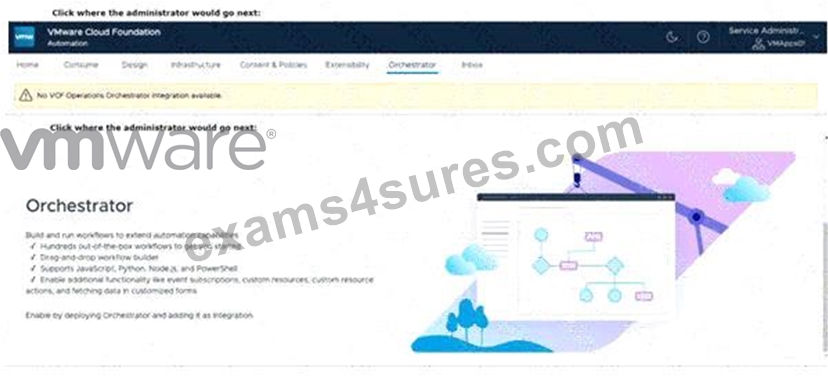
Answer:
Explanation: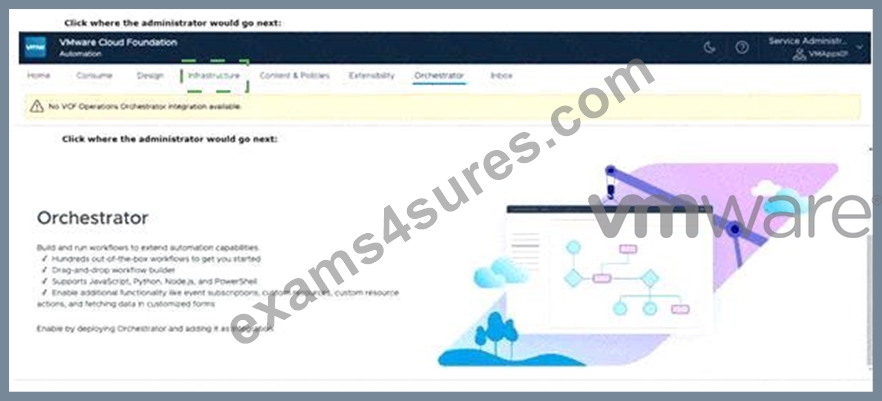
Explanation:
To enable the Orchestrator integration, the administrator must navigate to:
* Infrastructure (tab)
In VMware Cloud Foundation (VCF) 9.0, the VCF Operations Orchestrator (formerly vRealize Orchestrator) is a separate functional engine that must be explicitly integrated into the automation framework.
When an administrator selects the Orchestrator tab and encounters the warning message "No VCF Operations Orchestrator integration available," it indicates that the logical link between the Automation service and the Orchestrator appliance has not yet been established for that specific organization.
The standard administrative workflow to resolve this and enable extensibility is to move from the consumption/design view into the foundational infrastructure configuration. By clicking on the Infrastructure tab, the administrator gains access to global settings. From there, the administrator must navigate to Connections and then Integrations. Within the Integrations menu, the administrator can select "Add Integration" and specifically choose VCF Operations Orchestrator. This process requires providing the FQDN of the orchestrator server and appropriate service account credentials.
Once the integration is finalized and a successful data collection occurs, the portal's Orchestrator interface becomes functional, allowing users to build, run, and manage multi-cloud automation workflows across the VCF 9.0 fleet.
NEW QUESTION # 56
A Provider administrator received a technical requirement mandating the use of Identity Providers (IdP) in place of local accounts. The following requirements were defined:
* The source directory service must be different between the Provider Management Portal and Organizations.
* The Organization administrators cannot modify the identity provider configuration.
What two requirements should the administrator configure? (Choose two.)
- A. Configure and publish a custom organization role for all organizations.
- B. Setup custom LDAP service configuration per organization.
- C. Deploy an Identity Broker cluster per organization.
- D. Push the VCF Automation system LDAP service to all organizations.
- E. Ensure that "Do not use LDAP" is configured for each organization's SSO.
Answer: C,E
Explanation:
VCF 9.0 Automation uses a decentralized identity architecture to support complex multi-tenant requirements.
To ensure that the Provider Management Portal and Organizations use different source directories (e.g., the provider uses a management AD while tenants use their own OIDC/SAML IdPs), the administrator must Deploy an Identity Broker cluster per organization. The Identity Broker acts as the localized gateway for authentication for that specific tenant. To prevent Organization administrators from modifying these settings- satisfying the second requirement-the provider must Ensure that "Do not use LDAP" is configured for the organization's standard SSO settings. This configuration forces the organization to rely exclusively on the broker-mediated IdP managed at the provider level, effectively "locking" the identity configuration and preventing local tenant admins from reverting to a manual LDAP setup that might bypass corporate security policies or the centralized identity strategy.
NEW QUESTION # 57
An organization administrator has been tasked with adding a certificate to their organization in VCF Automation. What three actions are required? (Choose three.)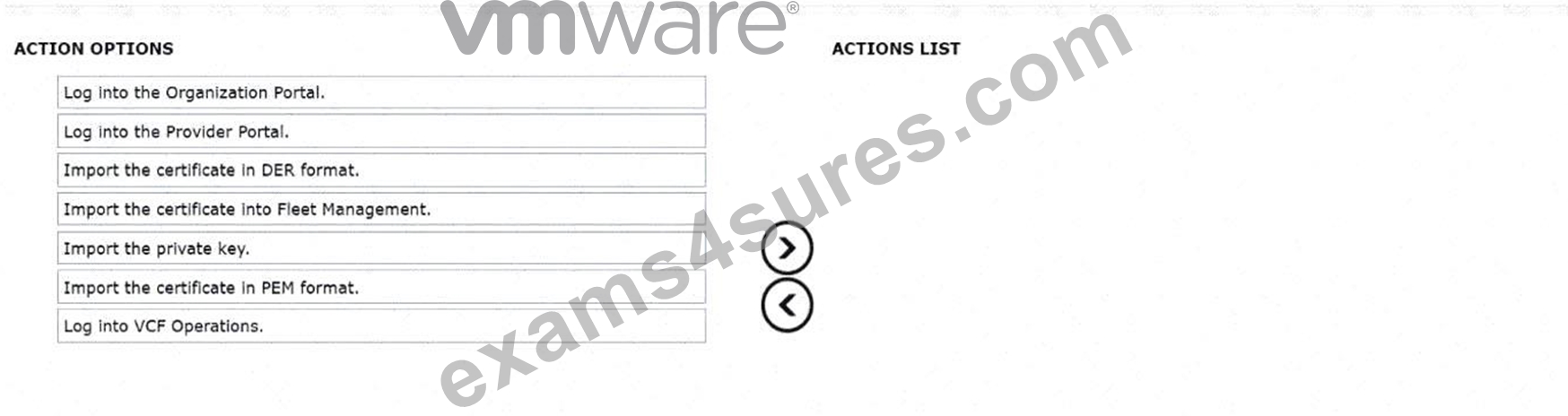
Answer:
Explanation: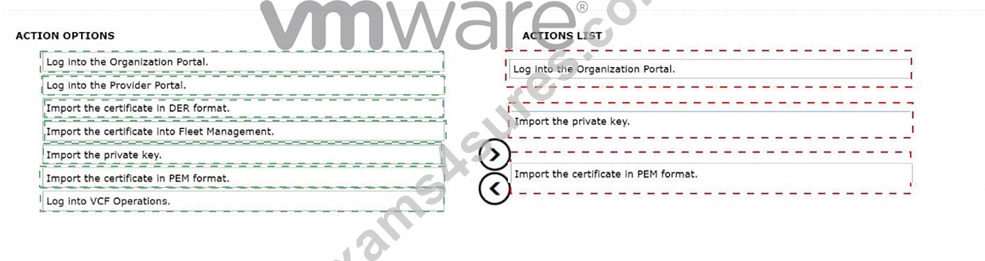
Explanation:
To add a certificate to an organization in VMware Cloud Foundation (VCF) Automation, the organization administrator must perform the following three required actions:
Answer
* Log into the Organization Portal.
* Import the private key.
* Import the certificate in PEM format.
In VCF Automation 9.0, managing identity and security at the tenant level is performed within the Organization Portal. This portal allows organization administrators to configure tenant-specific settings, including branding and certificates, independently of the provider.
The requirements for adding a certificate involve these key components:
* Administrative Interface: While global infrastructure certificates are managed in the Provider Portal, tenant-specific certificates used for securing an organization's internal services or custom domains are added through the Organization Portal.
* Certificate Format: Standard practice for these integrations is to use the PEM (Privacy Enhanced Mail) format, which is a base64 encoded text format widely supported for secure exchanges. The DER (Distinguished Encoding Rules) format is binary and typically not the primary requirement for these web-based portal imports.
* Security Pair: To establish a valid, secure connection, both the certificate itself and its associated private key must be imported into the organization's identity store. The private key is essential for the decryption process and must be handled securely during the import process.
NEW QUESTION # 58
Which VCF component is responsible for the automated lifecycle management (patching and upgrading) of the VCF Automation and VCF Operations appliances?
- A. SDDC Manager
- B. VCF Operations Orchestrator
- C. VMware Aria Suite Lifecycle
- D. vSphere Lifecycle Manager (vLCM)
Answer: A
Explanation:
In VCF 9.0, SDDC Manager is the centralized "source of truth" and lifecycle engine for the entire software- defined data center. While older versions of the stack relied on multiple standalone lifecycle managers, VCF
9.0 continues to consolidate these functions. SDDC Manager handles the end-to-end patching and upgrading of the management components, including the VCF Automation and VCF Operations appliances. It ensures that all components remain within a "Validated Solution" versioning matrix, preventing compatibility issues that could arise from manual upgrades. SDDC Manager orchestrates the download of bundles, performs pre- checks, and manages the non-disruptive rolling upgrades of these services, allowing the administrator to maintain a secure and up-to-date private cloud with minimal manual intervention.
NEW QUESTION # 59
An administrator is tasked with configuring an existing Organization to enable users to create namespaces with GPU resources on their assigned Projects.
The Organization is backed by a Region with a GPU-enabled supervisor on a single zone setup.
What needs to be configured for this requirement?
- A. NVIDIA GPU Operator.
- B. GPU enabled VM Classes.
- C. Namespace Class with VM Class Reservations.
- D. NVIDIA grid_al00-40c profile.
Answer: C
Explanation:
To deliver GPU resources to tenant users in VCF 9.0, the administrator must bridge the physical hardware to the logical project via a Namespace Class. Specifically, the administrator must create or modify a Namespace Class to include VM Class Reservations for GPU-enabled classes. In VCF 9.0, a "Namespace Class" defines the templates and limits for the Kubernetes namespaces that users can create. By adding a GPU-enabled VM Class (such as one utilizing NVIDIA vGPU profiles) to the reservation list within the Namespace Class, the administrator ensures that the Supervisor knows to prioritize and reserve those specific hardware resources for workloads deployed into that namespace. Once this Namespace Class is bound to the user's Project, the users can then select the GPU-enabled classes when deploying their containers or VMs, fulfilling the requirement for high-performance compute within the multi-tenant environment.
NEW QUESTION # 60
An administrator is reviewing the network topology of an AllApps Organization. They notice that while each Virtual Private Cloud (VPC) has its own private address space, there is a common component that handles the routing between these VPCs and the corporate backbone.
What is this component?
- A. NSX Tier-1 Gateway
- B. NSX Edge Cluster
- C. Distributed Logical Router
- D. NSX Transit Gateway
Answer: D
Explanation:
The NSX Transit Gateway (TGW) is the architectural cornerstone of regional networking in VCF 9.0. In previous versions, administrators had to manually manage complex Tier-0/Tier-1 relationships for each tenant; however, VCF 9.0 abstracts this through the TGW. When a Region is created, the system automatically instantiates the Transit Gateway to act as the high-speed "backplane" for the organization.
Every VPC created within that region connects to this TGW, which then handles all East-West traffic between VPCs and North-South traffic toward the corporate WAN or Internet. This design ensures that the routing logic is consistent, automated, and isolated from the physical underlying fabric. The TGW works in conjunction with VPC Connectivity Profiles to determine if a VPC is completely isolated or has an external path, providing a scalable and secure way to manage hundreds of isolated network segments without manual intervention.
NEW QUESTION # 61
......
3V0-21.25 Dumps Full Questions with Free PDF Questions to Pass: https://www.exams4sures.com/VMware/3V0-21.25-practice-exam-dumps.html
Free VCAP Automation 3V0-21.25 Official Cert Guide PDF Download: https://drive.google.com/open?id=1kiwtZXKnbw4TkbL-UVVjheylnUFq_8Ns