

Verified 1z0-915-1 dumps Q&As - 2025 Latest 1z0-915-1 Download
Updated 100% Cover Real 1z0-915-1 Exam Questions - 100% Pass Guarantee
Oracle 1z0-915-1 Exam Syllabus Topics:
| Topic | Details |
|---|---|
| Topic 1 |
|
| Topic 2 |
|
| Topic 3 |
|
| Topic 4 |
|
| Topic 5 |
|
| Topic 6 |
|
| Topic 7 |
|
| Topic 8 |
|
| Topic 9 |
|
NEW QUESTION # 37
You create a new MySQL DB system. It fails because you use mysql.sys as the administrator username.
What is the reason?
- A. The username must have at least 10 characters.
- B. mysql.sys is a reserved username that cannot be used in customer-defined user accounts.
- C. The username can contain only uppercase characters.
- D. The username cannot contain non-alphanumeric characters, such as a period.
Answer: B
Explanation:
The MySQL usermysql.sysis a reserved username used by the system for internal purposes. It cannot be used as a customer-defined user account to prevent conflicts with the system operations and maintain the integrity of the database's internal workings.
NEW QUESTION # 38
Which is true about exporting data to Object Storage with MySQL Shell util.dumpInstance?
- A. You must have a valid OCI CLI configuration.
- B. You must specify ocimds: true.
- C. You must provide an OCI username and password to gain write access to Object Storage.
- D. You must specify ociParManifest: true.
Answer: D
Explanation:
When exporting data to Object Storage withMySQL Shell util.dumpInstance,you must specify ociParManifest: true(Answer B). This option creates a pre-authenticated request (PAR) manifest file, which allows for secure access and upload to Object Storage without requiring direct credentials.
References:
* MySQL Shell Documentation
* OCI Object Storage Documentation
NEW QUESTION # 39
A DB system has been deleted successfully. Which two operations are allowed on the deleted DB system?
(Choose two.)
- A. Create a manual backup.
- B. Restore the DB system from an existing manual backup.
- C. View the API call logs on the Audit page.
- D. Change the storage size.
- E. View the metrics.
Answer: B,C
Explanation:
When a DB system has been successfully deleted, the following operations are allowed:
* Restore the DB system from an existing manual backup(Answer C): Even after the DB system is deleted, you can restore it from any existing manual backups. This allows you to recover the data and configuration from a point-in-time backup.
* View the API call logs on the Audit page(Answer E): You can view the API call logs related to the deleted DB system on the Audit page. These logs provide a record of actions taken on the DB system, including the deletion event.
References:
* OCI Backup and Restore Documentation
* OCI Audit Documentation
NEW QUESTION # 40
You want to restore a stand-alone DB system to a high-availability DB system with a point-in-time recovery.
Which three are required? (Choose three.)
- A. Point-in-time recovery must be enabled before the point in time to which you want to restore.
- B. The stand-alone DB system must remain active during the restore.
- C. Every user table must have a primary key.
- D. An automatic backup taken before the selected point in time must be available.
- E. A manual backup taken before the selected point in time must be available.
Answer: A,D,E
NEW QUESTION # 41
Which placement is NOT valid for a high-availability DB system? (Note: AD refers to availability domain and FD refers to fault domain.)
- A. Primary instance: AD1-FD3; Secondary instance 1: AD1-FD2; Secondary instance 2: AD1-FD3
- B. Primary instance: AD1-FD3; Secondary instance 1: AD2-FD2; Secondary instance 2: AD3-FD3
- C. Primary instance: AD1-FD1; Secondary instance 1: AD1-FD2; Secondary instance 2: AD1-FD3
- D. Primary instance: AD1-FD1; Secondary instance 1: AD2-FD2; Secondary instance 2: AD3-FD3
Answer: A
Explanation:
In a high-availability DB system, the placement of primary and secondary instances should ensure redundancy across different availability domains (ADs) and fault domains (FDs) to minimize downtime and data loss. The placement mentioned in option D is not valid because itplaces the primary and secondary instances in the same availability domain and fault domain, which does not provide high availability.
NEW QUESTION # 42
Which table option defines a Lakehouse external table based on a CSV file?
- A. ENGINE=csv SECONDARY_ENGINE=rapid ENGINE_ATTRIBUTE='{"file": [{"region":
"us-ashburn-1", "namespace": "mytenant", "bucket": "bucket01", "name": "airport.csv"}] }' - B. ENGINE=csv SECONDARY_ENGINE=lakehouse ENGINE_ATTRIBUTE='{"file": [{"region":
"us-ashburn-1", "namespace": "mytenant", "bucket": "bucket01", "name": "airport.csv"}] }' - C. ENGINE=lakehouse SECONDARY_ENGINE=csv ENGINE_ATTRIBUTE='{"file": [{"region":
"us-ashburn-1", "namespace": "mytenant", "bucket": "bucket01", "name": "airport.csv"}] }' - D. ENGINE=lakehouse SECONDARY_ENGINE=rapid ENGINE_ATTRIBUTE='{"file": [{"region":
"us-ashburn-1", "namespace": "mytenant", "bucket": "bucket01", "name": "airport.csv"}] }'
Answer: B
Explanation:
B:ENGINE=csv SECONDARY_ENGINE=lakehouse ENGINE_ATTRIBUTE='{"file": [{"region":
"us-ashburn-1", "namespace": "mytenant", "bucket": "bucket01", "name": "airport.csv"}] }': This table option defines a Lakehouse external table based on a CSV file. It specifies thecsvengine for the table and uses thelakehouseas the secondary engine, along with the file's location details in OCI Object Storage.
NEW QUESTION # 43
What must you do to minimize a DB system down time caused by automatic maintenance operations?
- A. Enable high availability.
- B. Create read replicas.
- C. Enable crash recovery.
- D. Add HeatWave cluster.
Answer: A
Explanation:
To minimize DB system downtime caused by automatic maintenance operations, you should enable high availability. High availability ensures that there are multiple instances of your database running in different fault domains or availability domains, reducing the impact of maintenance on the system's availability.
NEW QUESTION # 44
What happens when you perform a switchover of a high-availability DB system with an attached HeatWave cluster?
- A. The HeatWave cluster remains attached to the same DB system and the new primary instance redirects queries to that cluster.
- B. The HeatWave cluster is no longer valid; you must re-create the HeatWave cluster.
- C. The HeatWave cluster is attached to the new primary instance.
- D. The HeatWave cluster is deleted and a new HeatWave cluster is attached to the new primary instance.
Answer: C
Explanation:
When you perform a switchover of a high-availability DB system with an attached HeatWave cluster, theHeatWave cluster is attached to the new primary instance(Answer B). This ensures continuous operation and access to the HeatWave cluster's capabilities without the need to delete or re-create the cluster.
* During a switchover, the system promotes the standby instance to the primary role.
* The HeatWave cluster, which was previously attached to the original primary instance, is now re-attached to the new primary instance.
* This allows the new primary instance to continue processing queries using the HeatWave cluster seamlessly.
References:
* MySQL HeatWave High Availability Documentation
NEW QUESTION # 45
A port-forwarding Bastion session has been created for a MySQL DB system listening on 10.10.1.187:3306.
The SSH command provided by the Bastion session is:
An SSH tunnel is created successfully on a client machine by running this command:
Which command connects to the MySQL DB System from the client machine?
- A. mysqlsh mysql://[email protected]:3311
- B. mysqlsh mysql://[email protected]:3311
- C. mysqlsh mysql://[email protected]:3306
- D. mysqlsh mysql://[email protected]:3306
Answer: A
Explanation:
Given the SSH command sets up port forwarding from the local port3311to the remote MySQL DB system port3306, the correct command to connect to the MySQL DB system from the client machine is:
C:mysqlsh mysql://[email protected]:3311
This command connects to the local machine's port3311, which forwards the connection to the MySQL DB system at10.10.1.187:3306.
NEW QUESTION # 46
The first query has an estimated cost of 100,000,000 and is offloaded to a HeatWave cluster for execution:
SELECT flightno, departure, country FROM flight JOIN airport_geo ON 'from'=airport_id; The second query has an estimated cost of 10,000 and is NOT offloaded to the Heatwave cluster for execution:
SELECT DISTINCT country FROM airport_geo ORDER BY country;
Which two methods can offload the second query to the Heatwave cluster for execution? (Choose two.)
- A. CALL sys.heatwave_load('["airport_geo"]');
- B. CALL sys.heatwave_advisor(JSON_OBJECT("auto_enc", JSON_OBJECT("mode", "recommend")));
- C. SET optimizer_trace="enabled=on";
- D. SET secondary_engine_cost_threshold=1000;
- E. SET use_secondary_engine=FORCED;
Answer: D,E
Explanation:
To offload the second query to the HeatWave cluster for execution, you can use the following methods:
* SET use_secondary_engine=FORCED(Answer A): This forces the use of the HeatWave secondary engine for query execution, regardless of the estimated cost.
* SET secondary_engine_cost_threshold=1000(Answer B): This lowers the cost threshold for queries to be offloaded to the HeatWave cluster, allowing queries with lower estimated costs to be offloaded.
Steps:
* Before running the second query, executeSET use_secondary_engine=FORCED;to force the offloading of queries to HeatWave.
* Alternatively, executeSET secondary_engine_cost_threshold=1000;to adjust the cost threshold, making the second query eligible for offloading.
NEW QUESTION # 47
What is the benefit of creating a new DB system with data import?
- A. Smaller storage size with better compression
- B. Faster backup with a first full backup
- C. Faster import with minimal logging
- D. Consistent data with no user connection
Answer: C
Explanation:
Creating a new DB system with data import provides the benefit of faster import with minimal logging. This process is optimized to import large datasets efficiently and quickly, reducing the amount of logging overhead and ensuring a rapid setup of the new DB system.
NEW QUESTION # 48
Why would you select "Source cannot use GTID auto-positioning" when creating a channel?
- A. The source gtid mode is OFF.
- B. The binary log offset is unknown.
- C. Some tables have no primary key
- D. The target DB system is a high-availability DB system.
Answer: A
Explanation:
When creating a replication channel and selecting "Source cannot use GTID auto-positioning", it typically indicates that the source's GTID mode is off. GTID (Global Transaction Identifier) auto-positioning allows for automated recovery and positioning of transactions in replication, but it requires that GTID mode be enabled on the source database.
NEW QUESTION # 49
A query is not offloaded to the HeatWave cluster for execution. Which three are possible reasons? (Choose three.)
- A. A required column is excluded from the RAPID secondary engine.
- B. The user does not have privileges to access the HeatWave cluster.
- C. The query estimated cost is less than the query cost threshold.
- D. The use_secondary_engine session variable is OFF.
- E. The client is connected to the DB system instead of the HeatWave cluster.
Answer: A,D,E
Explanation:
A query may not be offloaded to the HeatWave cluster for execution due to the following reasons:
A:Theuse_secondary_enginesession variable is OFF: This setting controls whether queries should be offloaded to the secondary engine (HeatWave). B.The client is connected to the DB system instead of the HeatWave cluster: For queries to be offloaded, the client must be connected to the HeatWave cluster. E.A required column is excluded from the RAPID secondary engine: If a necessary column is not available in the HeatWave (RAPID) secondary engine, the query cannot be offloaded.
NEW QUESTION # 50
You want to restore a stand-alone DB system to a high-availability DB system with a point-in-time recovery.
Which three are required? (Choose three.)
- A. Point-in-time recovery must be enabled before the point in time to which you want to restore.
- B. The stand-alone DB system must remain active during the restore.
- C. Every user table must have a primary key.
- D. An automatic backup taken before the selected point in time must be available.
- E. A manual backup taken before the selected point in time must be available.
Answer: A,D,E
Explanation:
To restore a stand-alone DB system to a high-availability DB system with point-in-time recovery, the following are required:
B:Point-in-time recovery must be enabled before the point in time to which you want to restore: Point-in-time recovery (PITR) must be enabled beforehand to allow restoration to a specific point in time. C.An automatic backup taken before the selected point in time must be available: You need an automatic backup from before the desired restore point. D.A manual backup taken before the selected point in time must be available:
Manual backups are also essential to ensure you can restore to the desired point in time.
NEW QUESTION # 51
You want to deploy a high-availability MySQL DB system in a region with multiple availability domains.
Which two types of subnet provide maximum redundancy? (Choose two.)
- A. A public AD-specific subnet
- B. A private regional subnet
- C. A private AD-specific subnet
- D. A public regional subnet
Answer: B,D
Explanation:
To deploy a high-availability MySQL DB system in a region with multiple availability domains, the following types of subnets provide maximum redundancy:
* A private regional subnet(Answer B): This type of subnet spans all availability domains in the region, ensuring high availability and fault tolerance.
* A public regional subnet(Answer C): Similar to the private regional subnet, a public regional subnet spans all availability domains, providing maximum redundancy and accessibility.
References:
* OCI Networking Documentation
* MySQL High Availability Documentation
NEW QUESTION # 52
You create a MySQL DB system with default port numbers, and attach it to a subnet.
Which configuration is required on the subnet to enable client applications to connect to the DB system?
- A. Create an ingress rule that allows stateful connections on port 3306 and 33060.
- B. Create an egress rule that allows stateless connections on port 3306 and 33060.
- C. Create an egress rule that allows stateful connections on port 3306 and 33060.
- D. Create an ingress rule that allows stateless connections on port 3306 and 33060.
Answer: A
Explanation:
To enable client applications to connect to a MySQL DB system that uses default port numbers and is attached to a subnet, you need tocreate an ingress rule that allows stateful connections on port 3306 and 33060(Answer C).
* Ingress Rule: An ingress rule specifies the types of inbound connections that are allowed to a resource within a subnet.
* Stateful Connections: Stateful connections keep track of the state of network connections passing through them, allowing return traffic to pass automatically.
Steps:
* Navigate to the Virtual Cloud Network (VCN) in the OCI Console.
* Open the subnet to which the MySQL DB system is attached.
* Add an ingress rule to the subnet's security list to allow traffic on port 3306 (MySQL) and 33060 (MySQL X Protocol).
* Ensure the rule is stateful to maintain the connection state.
References:
* OCI Networking Documentation
* MySQL X Protocol Documentation
NEW QUESTION # 53
Which MySQL HeatWave AutoML routine evaluates a model?
- A. ML_EXPLAIN
- B. ML_PREDICT_TABLE
- C. ML_EXPLAIN_TABLE
- D. ML_SCORE
- E. ML_TRAIN
Answer: D
Explanation:
The MySQL HeatWave AutoML routine that evaluates a model isML_SCORE. This routine scores a trained machine learning model on a new dataset and evaluates its performance.
NEW QUESTION # 54
You want to train a model that predicts sales based on the available data the company holds.
This is an excerpt of thesalestable: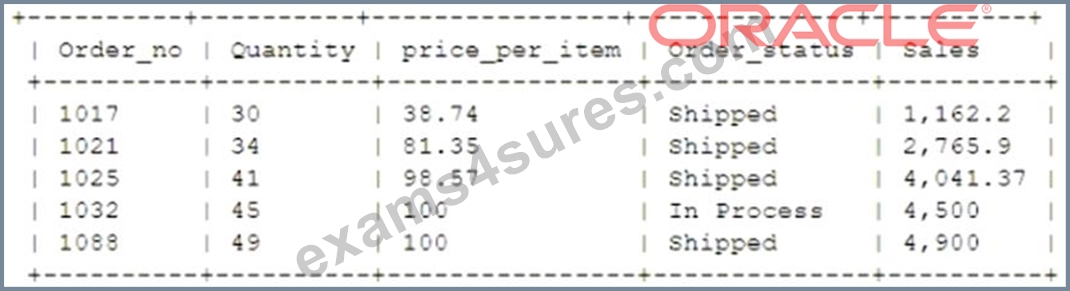
Which command trains the model?
- A. CALL sys.ML_TRAIN('ml_data.sales', 'Sales', JSON_OBJECT('task', 'regression'), @model);
- B. CALL sys.mML_TRAIN('ml_data.sales', 'Sales', JSON_OBJECT('task', 'forecasting'), @model);
- C. CALL sys.ML_TRAIN('ml_data.sales', 'Sales', JSON_OBJECT('task', 'classification'), @model);
- D. CALL sys.ML_TRAIN('ml_data.sales', 'Sales', JSON_OBJECT('task', 'anomaly_detection'),
@model);
Answer: A
Explanation:
To train a model that predicts sales, the appropriate machine learning task would be regression, as it involves predicting a continuous value (sales) based on the given data. The command to train such a model is:
D:CALL sys.ML_TRAIN('ml_data.sales', 'Sales', JSON_OBJECT('task', 'regression'), @model); This command calls theML_TRAINprocedure on theml_data.salestable, withSalesas the target variable, specifying the task as regression.
NEW QUESTION # 55
Which two are available when creating a new MySQL DB system in OCI Console? (Choose two.)
- A. Standalone server
- B. Read replica
- C. High availability
- D. HeatWave cluster
- E. Lakehouse
Answer: A,C
Explanation:
When creating a new MySQL DB system in the OCI Console, you have the following options:
* High availability(Answer A): This option allows you to create a DB system that can automatically fail over to a standby instance in case of hardware or software failure, ensuring minimal downtime.
* Standalone server(Answer C): This option lets you create a DB system with a single instance, suitable for workloads that do not require high availability or read replicas.
References:
* OCI MySQL Database Service Documentation
* MySQL High Availability
NEW QUESTION # 56
The following statements are executed successfully: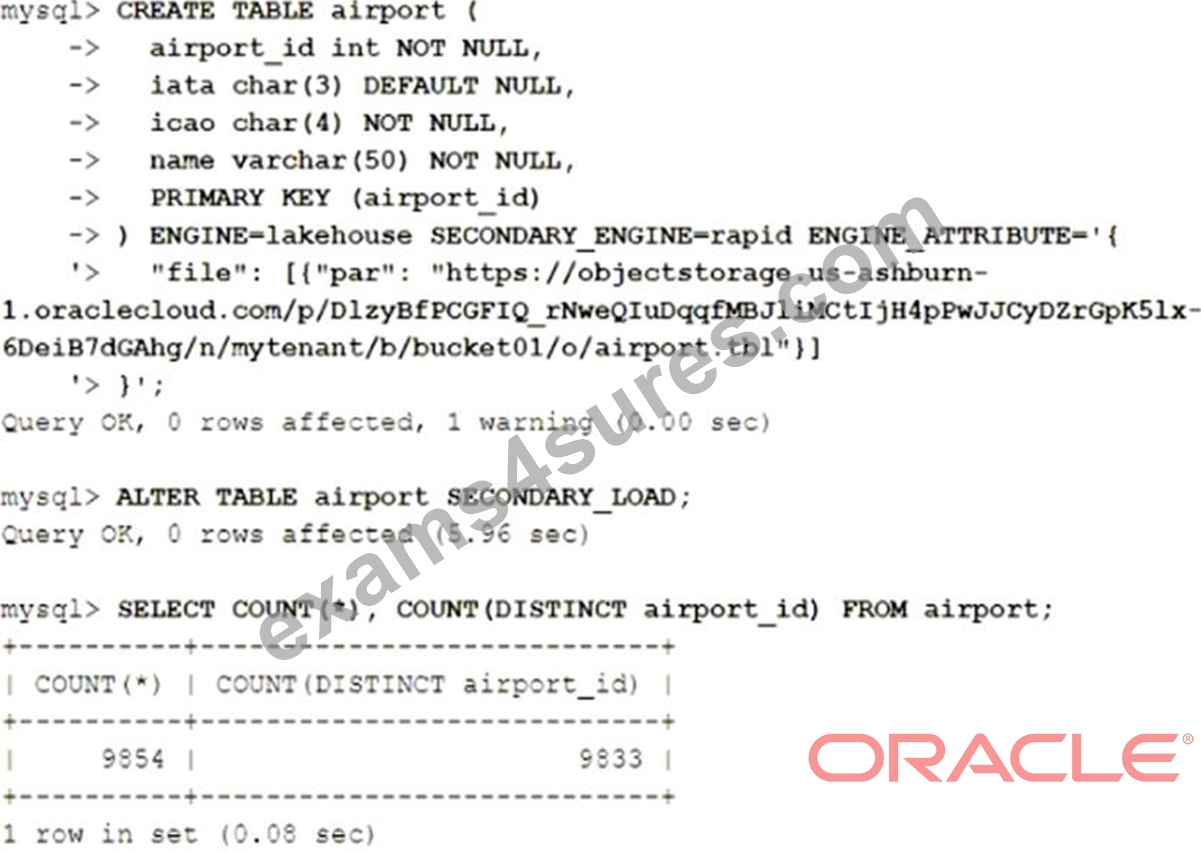
Which two are true? (Choose two.)
- A. The fields in the airport.tbl file are delimited by comma.
- B. The data of the airport table is loaded into the MySQL DB system.
- C. Every row in the airport table has a unique airport_id value.
- D. The airport.tbl file is in CSV format.
- E. The data placement key of the airport table is airport_id.
Answer: B,E
Explanation:
Based on the provided SQL statements, the following two are true:
* The data placement key of the airport table is airport_id(Answer A): The primary keyairport_idis used as the data placement key in theairporttable. This means that the data in the table is organized based on theairport_idvalues.
* The data of the airport table is loaded into the MySQL DB system(Answer D): TheALTER TABLE airport SECONDARY_LOAD;statement successfully loads the data from the specified object storage file into the MySQL DB system.
References:
* MySQL HeatWave Documentation
* MySQL Engine Attributes
NEW QUESTION # 57
What must you do before deleting a DB system?
- A. Take a manual backup
- B. Disable delete protection if it is enabled.
- C. Stop and remove any connected HeatWave Cluster.
- D. Stop the instance if it is running.
Answer: B
Explanation:
Before deleting a DB system in Oracle Cloud Infrastructure (OCI), you mustdisable delete protection if it is enabled(Answer C). Delete protection is a feature that prevents accidental deletion of DB systems. If enabled, it must be turned off before the DB system can be deleted.
Steps:
* Navigate to the DB system in the OCI Console.
* Check if delete protection is enabled.
* If enabled, disable it by updating the DB system settings.
* Proceed with deleting the DB system.
References:
* OCI Console Documentation on DB System Management
* MySQL Database Service Documentation
NEW QUESTION # 58
......
Use Real Dumps - 100% Free 1z0-915-1 Exam Dumps: https://www.exams4sures.com/Oracle/1z0-915-1-practice-exam-dumps.html
Realistic 1z0-915-1 Dumps Latest Practice Tests Dumps: https://drive.google.com/open?id=13nrCT1__ue4maUilR_EvPJwgfZyqJqKB