

[Nov 08, 2021] Get New DP-100 Certification Practice Test Questions Exam Dumps
Real DP-100 Exam Dumps Questions Valid DP-100 Dumps PDF
The Microsoft DP-100 test helps candidates check their machine learning knowledge and skills and prove themselves as qualified data scientists.
Ideal Candidate Profile
This exam will provide substantial career growth for data scientist-related job roles. If anyone’s job profile demands natural language processing and predictive analysis, s/he can aim at this exam to access needed expertise.
NEW QUESTION 39
Note: This question is part of a series of questions that present the same scenario. Each question in the series contains a unique solution that might meet the stated goals. Some question sets might have more than one correct solution, while others might not have a correct solution.
After you answer a question in this section, you will NOT be able to return to it. As a result, these questions will not appear in the review screen.
You are creating a model to predict the price of a student's artwork depending on the following variables: the student's length of education, degree type, and art form.
You start by creating a linear regression model.
You need to evaluate the linear regression model.
Solution: Use the following metrics: Mean Absolute Error, Root Mean Absolute Error, Relative Absolute Error, Accuracy, Precision, Recall, F1 score, and AUC.
Does the solution meet the goal?
- A. No
- B. Yes
Answer: A
Explanation:
Explanation
Accuracy, Precision, Recall, F1 score, and AUC are metrics for evaluating classification models.
Note: Mean Absolute Error, Root Mean Absolute Error, Relative Absolute Error are OK for the linear regression model.
References:
https://docs.microsoft.com/en-us/azure/machine-learning/studio-module-reference/evaluate-model
NEW QUESTION 40 
You must use the Azure Machine Learning SDK to interact with data and experiments in the workspace.
You need to configure the config.json file to connect to the workspace from the Python environment.
Which two additional parameters must you add to the config.json file in order to connect to the workspace?
Each correct answer presents part of the solution.
NOTE: Each correct selection is worth one point.
- A. Login
- B. Key
- C. subscription_Id
- D. region
- E. resource_group
Answer: C,E
Explanation:
Explanation
To use the same workspace in multiple environments, create a JSON configuration file. The configuration file saves your subscription (subscription_id), resource (resource_group), and workspace name so that it can be easily loaded.
The following sample shows how to create a workspace.
from azureml.core import Workspace
ws = Workspace.create(name='myworkspace',
subscription_id='<azure-subscription-id>',
resource_group='myresourcegroup',
create_resource_group=True,
location='eastus2'
)
Reference:
https://docs.microsoft.com/en-us/python/api/azureml-core/azureml.core.workspace.workspace
NEW QUESTION 41
You need to visually identify whether outliers exist in the Age column and quantify the outliers before the outliers are removed.
Which three Azure Machine Learning Studio modules should you use in sequence? To answer, move the appropriate modules from the list of modules to the answer area and arrange them in the correct order.
Answer:
Explanation:
Explanation:
You can use the Clip Values module in Azure Machine Learning Studio, to identify and optionally replace data values that are above or below a specified threshold. This is useful when you want to remove outliers or replace them with a mean, a constant, or other substitute value.
References:
https://blogs.msdn.microsoft.com/azuredev/2017/05/27/data-cleansing-tools-in-azure-machine-learning/
https://docs.microsoft.com/en-us/azure/machine-learning/studio-module-reference/clip-values
NEW QUESTION 42
You are building an intelligent solution using machine learning models.
The environment must support the following requirements:
* Data scientists must build notebooks in a cloud environment
* Data scientists must use automatic feature engineering and model building in machine learning pipelines.
* Notebooks must be deployed to retrain using Spark instances with dynamic worker allocation.
* Notebooks must be exportable to be version controlled locally.
You need to create the environment.
Answer:
Explanation:
Explanation:
Step 1: Create an Azure HDInsight cluster to include the Apache Spark Mlib library Step 2: Install Microsot Machine Learning for Apache Spark You install AzureML on your Azure HDInsight cluster.
Microsoft Machine Learning for Apache Spark (MMLSpark) provides a number of deep learning and data science tools for Apache Spark, including seamless integration of Spark Machine Learning pipelines with Microsoft Cognitive Toolkit (CNTK) and OpenCV, enabling you to quickly create powerful, highly-scalable predictive and analytical models for large image and text datasets.
Step 3: Create and execute the Zeppelin notebooks on the cluster
Step 4: When the cluster is ready, export Zeppelin notebooks to a local environment.
Notebooks must be exportable to be version controlled locally.
References:
https://docs.microsoft.com/en-us/azure/hdinsight/spark/apache-spark-zeppelin-notebook
https://azuremlbuild.blob.core.windows.net/pysparkapi/intro.html
NEW QUESTION 43
You create an experiment in Azure Machine Learning Studio- You add a training dataset that contains 10.000 rows. The first 9.000 rows represent class 0 (90 percent). The first 1.000 rows represent class 1 (10 percent).
The training set is unbalanced between two Classes. You must increase the number of training examples for class 1 to 4,000 by using data rows. You add the Synthetic Minority Oversampling Technique (SMOTE) module to the experiment.
You need to configure the module.
Which values should you use? To answer, select the appropriate options in the dialog box in the answer area.
NOTE: Each correct selection is worth one point.
Answer:
Explanation:
NEW QUESTION 44
Note: This question is part of a series of questions that present the same scenario. Each question in the series contains a unique solution that might meet the stated goals. Some question sets might have more than one correct solution, while others might not have a correct solution.
After you answer a question in this section, you will NOT be able to return to it. As a result, these questions will not appear in the review screen.
You are creating a new experiment in Azure Machine Learning Studio.
One class has a much smaller number of observations than the other classes in the training set.
You need to select an appropriate data sampling strategy to compensate for the class imbalance.
Solution: You use the Stratified split for the sampling mode.
Does the solution meet the goal?
- A. No
- B. Yes
Answer: A
Explanation:
Instead use the Synthetic Minority Oversampling Technique (SMOTE) sampling mode.
Note: SMOTE is used to increase the number of underepresented cases in a dataset used for machine learning. SMOTE is a better way of increasing the number of rare cases than simply duplicating existing cases.
References:
https://docs.microsoft.com/en-us/azure/machine-learning/studio-module-reference/smote
NEW QUESTION 45
Note: This question is part of a series of questions that present the same scenario. Each question in the series contains a unique solution that might meet the stated goals. Some question sets might have more than one correct solution, while others might not have a correct solution.
After you answer a question in this section, you will NOT be able to return to it. As a result, these questions will not appear in the review screen.
You are a data scientist using Azure Machine Learning Studio.
You need to normalize values to produce an output column into bins to predict a target column.
Solution: Apply a Quantiles normalization with a QuantileIndex normalization.
Does the solution meet the GOAL?
- A. No
- B. Yes
Answer: A
NEW QUESTION 46
You are performing a classification task in Azure Machine Learning Studio.
You must prepare balanced testing and training samples based on a provided data set.
You need to split the data with a 0.75:0.25 ratio.
Which value should you use for each parameter? To answer, select the appropriate options in the answer area.
NOTE: Each correct selection is worth one point.
Answer:
Explanation:
Reference:
https://docs.microsoft.com/en-us/azure/machine-learning/studio-module-reference/split-data
NEW QUESTION 47
Note: This question is part of a series of questions that present the same scenario. Each question in the series contains a unique solution that might meet the stated goals. Some question sets might have more than one correct solution, while others might not have a correct solution.
After you answer a question in this section, you will NOT be able to return to it. As a result, these questions will not appear in the review screen.
You train a classification model by using a logistic regression algorithm.
You must be able to explain the model's predictions by calculating the importance of each feature, both as an overall global relative importance value and as a measure of local importance for a specific set of predictions.
You need to create an explainer that you can use to retrieve the required global and local feature importance values.
Solution: Create a MimicExplainer.
Does the solution meet the goal?
- A. No
- B. Yes
Answer: A
Explanation:
Instead use Permutation Feature Importance Explainer (PFI).
Note 1: Mimic explainer is based on the idea of training global surrogate models to mimic blackbox models. A global surrogate model is an intrinsically interpretable model that is trained to approximate the predictions of any black box model as accurately as possible. Data scientists can interpret the surrogate model to draw conclusions about the black box model.
Note 2: Permutation Feature Importance Explainer (PFI): Permutation Feature Importance is a technique used to explain classification and regression models. At a high level, the way it works is by randomly shuffling data one feature at a time for the entire dataset and calculating how much the performance metric of interest changes. The larger the change, the more important that feature is. PFI can explain the overall behavior of any underlying model but does not explain individual predictions.
Reference:
https://docs.microsoft.com/en-us/azure/machine-learning/how-to-machine-learning-interpretability
NEW QUESTION 48
You create a binary classification model by using Azure Machine Learning Studio.
You must tune hyperparameters by performing a parameter sweep of the model. The parameter sweep must meet the following requirements:
* iterate all possible combinations of hyperparameters
* minimize computing resources required to perform the sweep
* You need to perform a parameter sweep of the model.
Which parameter sweep mode should you use?
- A. Random grid
- B. Random sweep
- C. Entire grid
- D. Sweep clustering
- E. Random seed
Answer: A
Explanation:
Maximum number of runs on random grid: This option also controls the number of iterations over a random sampling of parameter values, but the values are not generated randomly from the specified range; instead, a matrix is created of all possible combinations of parameter values and a random sampling is taken over the matrix. This method is more efficient and less prone to regional oversampling or undersampling.
If you are training a model that supports an integrated parameter sweep, you can also set a range of seed values to use and iterate over the random seeds as well. This is optional, but can be useful for avoiding bias introduced by seed selection.
Incorrect Answers:
B: If you are building a clustering model, use Sweep Clustering to automatically determine the optimum number of clusters and other parameters.
C: Entire grid: When you select this option, the module loops over a grid predefined by the system, to try different combinations and identify the best learner. This option is useful for cases where you don't know what the best parameter settings might be and want to try all possible combination of values.
E: If you choose a random sweep, you can specify how many times the model should be trained, using a random combination of parameter values.
References:
https://docs.microsoft.com/en-us/azure/machine-learning/studio-module-reference/tune-model-hyperparameters
NEW QUESTION 49
Note: This question is part of a series of questions that present the same scenario. Each question in the series contains a unique solution that might meet the stated goals. Some question sets might have more than one correct solution, while others might not have a correct solution.
After you answer a question in this section, you will NOT be able to return to it. As a result, these questions will not appear in the review screen.
You are analyzing a numerical dataset which contains missing values in several columns.
You must clean the missing values using an appropriate operation without affecting the dimensionality of the feature set.
You need to analyze a full dataset to include all values.
Solution: Calculate the column median value and use the median value as the replacement for any missing value in the column.
Does the solution meet the goal?
- A. No
- B. Yes
Answer: A
Explanation:
Explanation
Use the Multiple Imputation by Chained Equations (MICE) method.
References:
https://www.ncbi.nlm.nih.gov/pmc/articles/PMC3074241/
https://docs.microsoft.com/en-us/azure/machine-learning/studio-module-reference/clean-missing-data
NEW QUESTION 50
You need to define an evaluation strategy for the crowd sentiment models.
Which three actions should you perform in sequence? To answer, move the appropriate actions from the list of actions to the answer area and arrange them in the correct order.
Answer:
Explanation:
Explanation:
Step 1: Define a cross-entropy function activation
When using a neural network to perform classification and prediction, it is usually better to use cross-entropy error than classification error, and somewhat better to use cross-entropy error than mean squared error to evaluate the quality of the neural network.
Step 2: Add cost functions for each target state.
Step 3: Evaluated the distance error metric.
References:
https://www.analyticsvidhya.com/blog/2018/04/fundamentals-deep-learning-regularization-techniques/
NEW QUESTION 51
You need to implement a feature engineering strategy for the crowd sentiment local models.
What should you do?
- A. Apply a linear discriminant analysis.
- B. Apply a Pearson correlation coefficient.
- C. Apply a Spearman correlation coefficient.
- D. Apply an analysis of variance (ANOVA).
Answer: A
Explanation:
Explanation
The linear discriminant analysis method works only on continuous variables, not categorical or ordinal variables.
Linear discriminant analysis is similar to analysis of variance (ANOVA) in that it works by comparing the means of the variables.
Scenario:
Data scientists must build notebooks in a local environment using automatic feature engineering and model building in machine learning pipelines.
Experiments for local crowd sentiment models must combine local penalty detection data.
All shared features for local models are continuous variables.
NEW QUESTION 52
You need to configure the Edit Metadata module so that the structure of the datasets match.
Which configuration options should you select? To answer, select the appropriate options in the answer area.
NOTE: Each correct selection is worth one point.
Answer:
Explanation:
Explanation
Box 1: Floating point
Need floating point for Median values.
Scenario: An initial investigation shows that the datasets are identical in structure apart from the MedianValue column. The smaller Paris dataset contains the MedianValue in text format, whereas the larger London dataset contains the MedianValue in numerical format.
Box 2: Unchanged
Note: Select the Categorical option to specify that the values in the selected columns should be treated as categories.
For example, you might have a column that contains the numbers 0,1 and 2, but know that the numbers actually mean "Smoker", "Non smoker" and "Unknown". In that case, by flagging the column as categorical you can ensure that the values are not used in numeric calculations, only to group data.
NEW QUESTION 53
You are creating an experiment by using Azure Machine Learning Studio.
You must divide the data into four subsets for evaluation. There is a high degree of missing values in the dat a. You must prepare the data for analysis.
You need to select appropriate methods for producing the experiment.
Which three modules should you run in sequence? To answer, move the appropriate actions from the list of actions to the answer area and arrange them in the correct order.
NOTE: More than one order of answer choices is correct. You will receive credit for any of the correct orders you select.
Answer:
Explanation:
Explanation:
The Clean Missing Data module in Azure Machine Learning Studio, to remove, replace, or infer missing values.
Incorrect Answers:
Latent Direchlet Transformation: Latent Dirichlet Allocation module in Azure Machine Learning Studio, to group otherwise unclassified text into a number of categories. Latent Dirichlet Allocation (LDA) is often used in natural language processing (NLP) to find texts that are similar. Another common term is topic modeling.
Build Counting Transform: Build Counting Transform module in Azure Machine Learning Studio, to analyze training data. From this data, the module builds a count table as well as a set of count-based features that can be used in a predictive model.
Missing Value Scrubber: The Missing Values Scrubber module is deprecated.
Feature hashing: Feature hashing is used for linguistics, and works by converting unique tokens into integers.
Replace discrete values: the Replace Discrete Values module in Azure Machine Learning Studio is used to generate a probability score that can be used to represent a discrete value. This score can be useful for understanding the information value of the discrete values.
References:
https://docs.microsoft.com/en-us/azure/machine-learning/studio-module-reference/clean-missing-data
NEW QUESTION 54
You need to correct the model fit issue.
Which three actions should you perform in sequence? To answer, move the appropriate actions from the list of actions to the answer area and arrange them in the correct order.
Answer:
Explanation:
1 - Augment the data
2 - Add the Bayesian Linear Regression module.
3 - Configure the regularization weight.
NEW QUESTION 55
Note: This question is part of a series of questions that present the same scenario. Each question in the series contains a unique solution that might meet the stated goals. Some question sets might have more than one correct solution, while others might not have a correct solution.
After you answer a question in this section, you will NOT be able to return to it. As a result, these questions will not appear in the review screen.
You train a classification model by using a logistic regression algorithm.
You must be able to explain the model's predictions by calculating the importance of each feature, both as an overall global relative importance value and as a measure of local importance for a specific set of predictions.
You need to create an explainer that you can use to retrieve the required global and local feature importance values.
Solution: Create a PFIExplainer.
Does the solution meet the goal?
- A. No
- B. Yes
Answer: B
Explanation:
Permutation Feature Importance Explainer (PFI): Permutation Feature Importance is a technique used to explain classification and regression models. At a high level, the way it works is by randomly shuffling data one feature at a time for the entire dataset and calculating how much the performance metric of interest changes. The larger the change, the more important that feature is. PFI can explain the overall behavior of any underlying model but does not explain individual predictions.
Reference:
https://docs.microsoft.com/en-us/azure/machine-learning/how-to-machine-learning-interpretability
NEW QUESTION 56
You need to build a feature extraction strategy for the local models.
How should you complete the code segment? To answer, select the appropriate options in the answer area.
NOTE: Each correct selection is worth one point.
Answer:
Explanation:
Explanation
NEW QUESTION 57
You use the Two-Class Neural Network module in Azure Machine Learning Studio to build a binary classification model. You use the Tune Model Hyperparameters module to tune accuracy for the model.
You need to configure the Tune Model Hyperparameters module.
Which two values should you use? Each correct answer presents part of the solution.
NOTE: Each correct selection is worth one point.
- A. Number of hidden nodes
- B. Number of learning iterations
- C. Hidden layer specification
- D. The type of the normalizer
- E. Learning Rate
Answer: B,C
Explanation:
D: For Number of learning iterations, specify the maximum number of times the algorithm should process the training cases.
E: For Hidden layer specification, select the type of network architecture to create.
Between the input and output layers you can insert multiple hidden layers. Most predictive tasks can be accomplished easily with only one or a few hidden layers.
Reference:
https://docs.microsoft.com/en-us/azure/machine-learning/studio-module-reference/two-class-neural-network
NEW QUESTION 58
You create a script that trains a convolutional neural network model over multiple epochs and logs the validation loss after each epoch. The script includes arguments for batch size and learning rate.
You identify a set of batch size and learning rate values that you want to try.
You need to use Azure Machine Learning to find the combination of batch size and learning rate that results in the model with the lowest validation loss.
What should you do?
- A. Use the Automated Machine Learning interface in Azure Machine Learning studio
- B. Run the script in an experiment based on an AutoMLConfig object
- C. Run the script in an experiment based on a HyperDriveConfig object
- D. Create a PythonScriptStep object for the script and run it in a pipeline
- E. Run the script in an experiment based on a ScriptRunConfig object
Answer: C
Explanation:
Box 1: import pytorch as deeplearninglib
Box 2: ..DistributedSampler(Sampler)..
DistributedSampler(Sampler):
Sampler that restricts data loading to a subset of the dataset.
It is especially useful in conjunction with class:`torch.nn.parallel.DistributedDataParallel`. In such case, each process can pass a DistributedSampler instance as a DataLoader sampler, and load a subset of the original dataset that is exclusive to it.
Scenario: Sampling must guarantee mutual and collective exclusively between local and global segmentation models that share the same features.
Box 3: optimizer = deeplearninglib.train. GradientDescentOptimizer(learning_rate=0.10) Incorrect Answers: ..SGD..
Scenario: All penalty detection models show inference phases using a Stochastic Gradient Descent (SGD) are running too slow.
Box 4: .. nn.parallel.DistributedDataParallel..
DistributedSampler(Sampler): The sampler that restricts data loading to a subset of the dataset.
It is especially useful in conjunction with :class:`torch.nn.parallel.DistributedDataParallel`.
References:
https://github.com/pytorch/pytorch/blob/master/torch/utils/data/distributed.py Reference:
https://docs.microsoft.com/en-us/azure/machine-learning/how-to-tune-hyperparameters
NEW QUESTION 59
You register a model that you plan to use in a batch inference pipeline.
The batch inference pipeline must use a ParallelRunStep step to process files in a file dataset. The script has the ParallelRunStep step runs must process six input files each time the inferencing function is called.
You need to configure the pipeline.
Which configuration setting should you specify in the ParallelRunConfig object for the PrallelRunStep step?
- A. process_count_per_node= "6"
- B. node_count= "6"
- C. mini_batch_size= "6"
- D. error_threshold= "6"
Answer: B
Explanation:
Explanation
node_count is the number of nodes in the compute target used for running the ParallelRunStep.
Reference:
https://docs.microsoft.com/en-us/python/api/azureml-contrib-pipeline-steps/azureml.contrib.pipeline.steps.parall
NEW QUESTION 60
You need to configure the Feature Based Feature Selection module based on the experiment requirements and datasets.
How should you configure the module properties? To answer, select the appropriate options in the dialog box in the answer area.
NOTE: Each correct selection is worth one point.
Answer:
Explanation:
Explanation
Box 1: Mutual Information.
The mutual information score is particularly useful in feature selection because it maximizes the mutual information between the joint distribution and target variables in datasets with many dimensions.
Box 2: MedianValue
MedianValue is the feature column, , it is the predictor of the dataset.
Scenario: The MedianValue and AvgRoomsinHouse columns both hold data in numeric format. You need to select a feature selection algorithm to analyze the relationship between the two columns in more detail.
References:
https://docs.microsoft.com/en-us/azure/machine-learning/studio-module-reference/filter-based-feature-selection
NEW QUESTION 61
You need to implement a new cost factor scenario for the ad response models as illustrated in the performance curve exhibit.
Which technique should you use?
- A. Set the threshold to 0.2 and retrain if weighted Kappa deviates +/- 5% from 0.6.
- B. Set the threshold to 0.5 and retrain if weighted Kappa deviates +/- 5% from 0.45.
- C. Set the threshold to 0.75 and retrain if weighted Kappa deviates +/- 5% from 0.15.
- D. Set the threshold to 0.05 and retrain if weighted Kappa deviates +/- 5% from 0.5.
Answer: B
Explanation:
Scenario:
Performance curves of current and proposed cost factor scenarios are shown in the following diagram: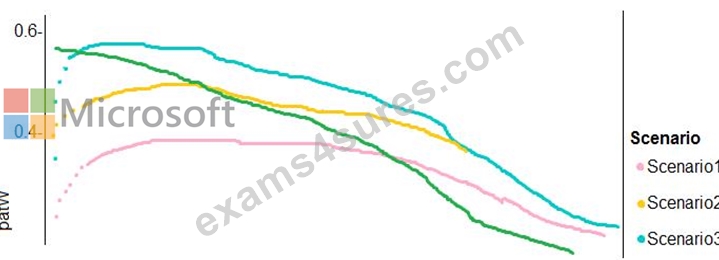
The ad propensity model uses a cut threshold is 0.45 and retrains occur if weighted Kappa deviated from 0.1 +/- 5%.
You are a data scientist for Fabrikam Residences, a company specializing in quality private and commercial property in the United States. Fabrikam Residences is considering expanding into Europe and has asked you to investigate prices for private residences in major European cities. You use Azure Machine Learning Studio to measure the median value of properties. You produce a regression model to predict property prices by using the Linear Regression and Bayesian Linear Regression modules.
NEW QUESTION 62 
For each of the following statements, select Yes if the statement is true. Otherwise, select No. NOTE: Each correct selection is worth one point.
Answer:
Explanation:
NEW QUESTION 63
......
DP-100 Exam Dumps - PDF Questions and Testing Engine: https://www.exams4sures.com/Microsoft/DP-100-practice-exam-dumps.html
Latest DP-100 Exam Dumps for Pass Guaranteed: https://drive.google.com/open?id=1z_t1QF1K6coF251vGrz0YTTvtjYoAuj4