

UiPath-ADAv1 Dumps To Pass UiPath Certified Professional - Developer Track Exam in One Day (Updated 256 Questions)
UiPath-ADAv1 Exam Brain Dumps - Study Notes and Theory
NEW QUESTION # 82
Review the following graphics:


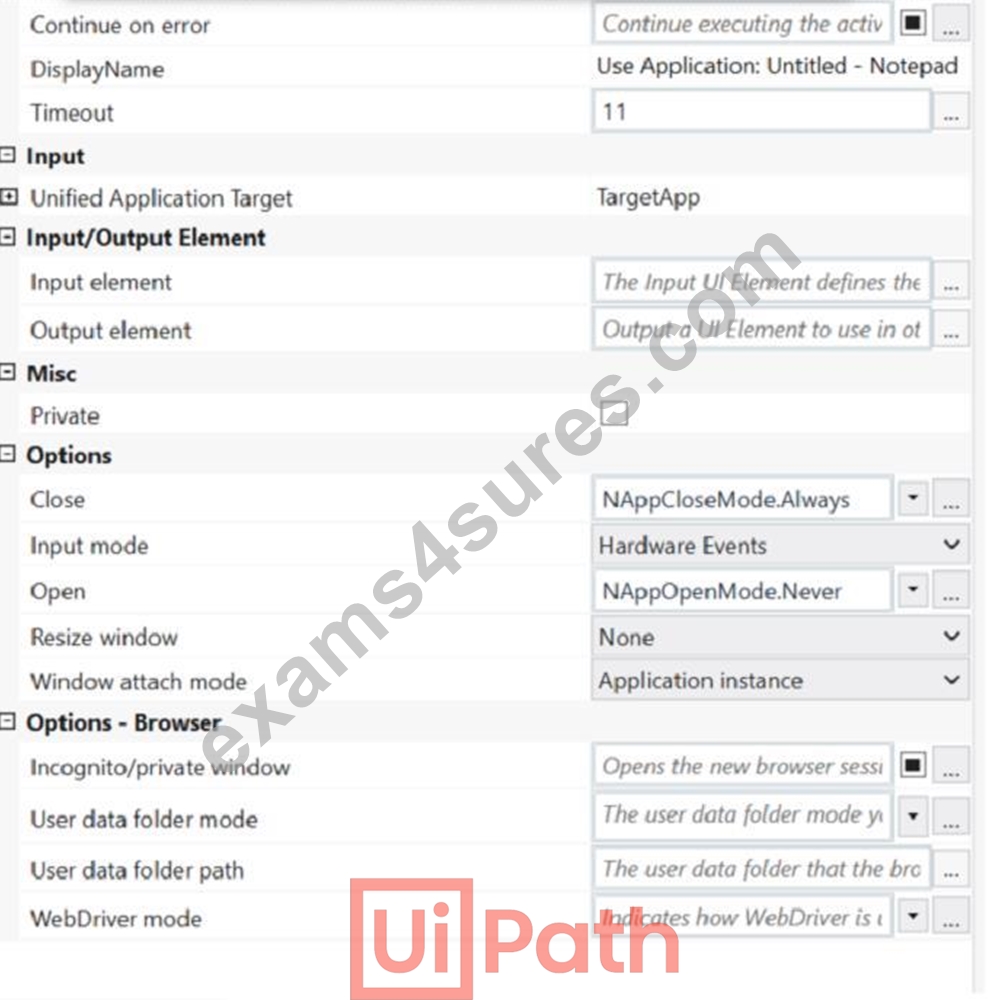

If the automation is executed and Notepad.exe is not running, which Log Message text value is contained in the Output panel?
- A. ApplicationNotFoundException
- B. SelectorNotFoundException
- C. Exception
- D. Try
Answer: B
Explanation:
Explanation
Based on the image you sent, the automation process consists of four steps: opening Notepad.exe, typing some text, saving the file, and closing Notepad.exe. Each step has a Log Message activity that writes a text value to the Output panel. If Notepad.exe is not running, the first step will fail and throw an exception. The exception type is SelectorNotFoundException, because the Open Application activity cannot find the selector for Notepad.exe1. Therefore, the Log Message text value that is contained in the Output panel is
"SelectorNotFoundException", which is option D.
References: Open Application documentation.
NEW QUESTION # 83
The following table is stored in a variable called "dt".
What will the value of the qty variable be after executing the Assign activity?
- A. 0
- B. 1
- C. 2
- D. null
Answer: A
Explanation:
Explanation
The Assign activity is used to assign a value to a variable. In this case, the variable is "qty". The value of the variable will be 80 after executing the Assign activity because the expression in the Assign activity is
"dt.AsEnumerable().Where(Function(x) x("Item").ToString.Equals("mango")).Select(Function(y) y("Quantity")).ToString". This expression is filtering the data table "dt" for rows where the "Item" column is equal to "mango" and then selecting the "Quantity" column from those rows. Since there is only one row in the data table where "Item" is equal to "mango", the value of the "Quantity" column in that row is 80. (UiPath Studio documentation)
References:
: [Assign - UiPath Activities].
NEW QUESTION # 84
Suppose a developer is working with a 2023 yearly calendar. To expand the calendar into a monthly view, the developer must always click on the 15th day of the current month and add an event.
The selector for the Event Date Element activity in March is presented as follows:
<wnd app='applicationframehost.exe' title='Month View - Calendar' />
<uia cls='Day' name='15 March 2023' />
How should the selector be altered to guarantee that it clicks on the 15th of the ongoing month?
- A. <wnd app='applicationframehost.exe' title='Month View - Calendar' />
<uia cls='Day' name='15* 20 ?? ' /> - B. <wnd app='applicationframehost.exe' title='Month View - Calendar' />
<uia cls='Day' name='15 ? 20 ?? ' /> - C. <wnd app='applicationframehost.exe' title='Month View - Calendar' />
<uia cls='Day' name='15 * 2023' /> - D. <wnd app='applicationframehost.exe' title='Month View - Calendar' />
<uia cls='Day' name='*15*' />
Answer: A
Explanation:
This is the correct option because it uses wildcards to replace the dynamic parts of the selector. Wildcards are symbols that enable you to replace zero or multiple characters in a string. They are useful when dealing with attributes that change dynamically in the selector. There are two types of wildcards: asterisk () and question mark (?). The asterisk () replaces zero or more characters, while the question mark (?) replaces a single character. In this case, the name attribute of the target element changes according to the month, but the day and the year remain constant. Therefore, the selector can be altered by replacing the month name with an asterisk () and the last two digits of the year with two question marks (??). This way, the selector will match any element that has the name starting with 15, followed by any characters, followed by 20, followed by any two characters. For example, the selector will match 15 March 2023, 15 April 2023, 15 May 2023, etc. The other options are incorrect because they either do not use wildcards, or they use them incorrectly. Option A does not replace the last two digits of the year, which may change in the future. Option C replaces too many characters with the asterisk (), which may cause ambiguity or false matches. Option D uses the question mark (?) incorrectly, as it should be used for single characters, not for spaces or multiple characters. References: Selectors With Wildcards
NEW QUESTION # 85
In a UiPath State Machine workflow, which section of State activity is used to specify conditional/triggers logic and multiple outgoing transitions in a state machine?
- A. Transitions
- B. Entry
- C. Exit
- D. Triggers
Answer: D
Explanation:
Explanation
The Triggers section of the State activity is used to specify the conditional or trigger logic and multiple outgoing transitions in a state machine. A trigger is a condition that evaluates to true or false and determines whether the state machine should move from one state to another. A transition is a link between two states that defines the direction of the state machine flow. You can add multiple triggers and transitions to a state and configure their properties, such as priority, display name, and action. (UiPath Studio documentation1) References:
1: State - UiPath Activities.
NEW QUESTION # 86
A developer wants to invoke a workflow in Main xaml called ProcessPurchaseOrders.xamI. Data needs to be passed to and from the invoked workflow What is the correct sequence of steps the developer needs to perform?
Instructions: Drag the Description found on the left and drop on the correct Step found on the right
Answer:
Explanation:
Explanation
The correct sequence of steps the developer needs to perform is:
Step 1 = Create the ProcessPurchaseOrders.xaml file
Step 2 = Open the ProcessPurchaseOrders.xaml file and create the arguments Step 3 = Invoke the ProcessPurchaseOrders.xaml file in the Main.xaml file and click Import Arguments Step 4 = Pass the values of the arguments to/from the variables in the Main.xaml file This sequence will ensure that the developer can create a reusable workflow, invoke it from the main workflow, and pass data between them using arguments.
https://forum.uipath.com/t/import-arguments-in-invoke-workflow-file/1923
https://forum.uipath.com/t/pass-arguments-invoke/132595
NEW QUESTION # 87
A developer wants to assign the first row of the "ID" column in the "DT" datatable to a String variable. Which expression should be added to the Value field of the Assign activity?
- A. DTColumns(0)ID
- B. DTRows(0)ID
- C. DTRows(0). ltem("ID")
- D. DTColumns(0) ("ID")
Answer: C
Explanation:
Explanation
To assign the first row of the "ID" column in the "DT" datatable to a String variable, the expression that should be added to the Value field of the Assign activity is:
DT.Rows(0).Item("ID")
This expression accesses the value of the "ID" column in the first row of the "DT" datatable using the Rows and Item properties. The Rows property returns a collection of DataRow objects that represent the rows in the datatable. The Item property returns or sets the value of the specified column in the DataRow object1. The expression uses the index 0 to refer to the first row in the Rows collection, and the column name "ID" to refer to the specific column in the Item property. The expression returns the value of the "ID" column in the first row as an Object type, which can be converted to a String type using the ToString method2. For example, if the "DT" datatable has the following values:
ID
Name
1
John
2
Mary
3
Bob
Then the expression DT.Rows(0).Item("ID") will return 1 as the value of the "ID" column in the first row.
References: DataTable.Rows Property and DataRow.Item Property from UiPath documentation.
NEW QUESTION # 88
Which of the following options is correct regarding the below Object Repository tree structure?
- A. One Application
Two UI Elements
Five Screens - B. One Screen
Two Applications
Five UI Elements - C. One Application
Two Screens
Five UI Elements - D. One Library
One Application
Two Screens
Five UI Elements
Answer: C
Explanation:
Explanation
The Object Repository tree structure shows one application with two screens and five UI elements. The application is the top-level node, the screens are the second-level nodes, and the UI elements are the third-level nodes. The UI elements have properties, selectors, and images that define them.
https://docs.uipath.com/studio/docs/about-the-object-repository
NEW QUESTION # 89
A developer downloads a published package from UiPath Orchestrator 2021.10 to use locally. What is the extension of the downloaded package?
- A. .zip
- B. .dll
- C. .csproj
- D. .nupkg
Answer: D
Explanation:
The extension of the downloaded package from UiPath Orchestrator 2021.10 to use locally is .nupkg. A package is a file that contains the workflows and the dependencies of a project that is ready to be executed by a robot. A package can be created and published from UiPath Studio, or uploaded manually to UiPath Orchestrator. A package can also be downloaded from UiPath Orchestrator to use locally, such as for debugging or testing purposes. The extension of the package file is .nupkg, which is the standard extension for NuGet packages. NuGet is a package manager that is used to manage the dependencies of a project, such as libraries, frameworks, or components3. A .nupkg file is essentially a ZIP archive that contains the files and metadata of the package4. For example, if a package named Process1 is downloaded from UiPath Orchestrator, the file name and extension will be Process1.nupkg. The .nupkg file can be opened or extracted using a ZIP utility, such as 7-Zip or WinZip, or renamed to .zip and extracted using Windows Explorer5.
NEW QUESTION # 90
Which variable field is optional when creating a variable, in UiPath Studio?
- A. Default
- B. Variable type
- C. Scope
- D. Name
Answer: A
Explanation:
In UiPath Studio, when creating a variable, the "Default" field is optional. The "Default" field is where you can assign an initial value to the variable, which it will hold until changed during the execution of the workflow. The "Variable type" must be specified to determine what kind of data the variable will hold. The
"Name" is required to reference the variable within the workflow, and the "Scope" determines where the variable can be accessed from within the project.
References:
UiPath Studio Guide: Managing Variables
NEW QUESTION # 91
What happens after executing the given sequence if the Work Items button appears on the screen after 8 seconds and the Retry Scope activity has the properties as shown in the picture?


- A. An exception is being thrown.
- B. Nothing happens.
- C. The Work Items button is being highlighted.
- D. The Work Items button is being clicked.
Answer: D
Explanation:
The Retry Scope activity is used to retry the execution of a specific part of the automation in case of an error.
In this case, the properties of the Retry Scope activity are set to retry 3 times with an interval of 8 seconds.
Therefore, if the Work Items button appears on the screen after 8 seconds, the activity will click on the button. References: [Activities - Retry Scope]
NEW QUESTION # 92
In which situation will a Ul Automation activity generate a partial selector?
- A. When included in a Trigger Scope activity
- B. When included in an Excel Application Scope activity
- C. When included in an Attach Browser activity
- D. When included after a Find Element activity
Answer: C
Explanation:
Explanation
A partial selector is a selector that does not contain the information about the top-level window. A partial selector is usually generated when a UI Automation activity is included in a container activity, such as Attach Browser or Attach Window, that has a full selector of the outer window. This way, the UI Automation activity can use the partial selector relative to the container, instead of the full selector from the root. Therefore, the answer is B. When included in an Attach Browser activity. References: Full Versus Partial Selectors, Attach Browser
NEW QUESTION # 93
Which logging level includes the following information by default?
1. Execution Started log entry - generated every time a process is started.
2. Execution Ended log entry - generated every time a process is finalized.
3. Transaction Started log entry - generated every time a transaction item is obtained by the robot from Orchestrator.
4. Transaction Ended log entry - generated every time the robot sets the transaction status to either Success or Failed.
5. Activity Information log entry - generated every time an activity is started, faulted or finished inside a workflow.
6. Arguments and Variables Information log entry - show values of the variables and arguments that are used.
- A. Verbose
- B. Information
- C. Trace
- D. Critical
Answer: A
Explanation:
The Verbose logging level includes all the information that is logged by the other levels, plus the values of the variables and arguments that are used in the process1. By default, the Verbose level includes the following log entries2:
Execution Started
Execution Ended
Transaction Started
Transaction Ended
Activity Information
Arguments and Variables Information
https://docs.uipath.com/robot/standalone/2023.4/user-guide/logging-and-log-levels
NEW QUESTION # 94
A developer configured the properties for a Click activity as shown below:
What happens if the activity cannot find its target at runtime?
- A. An exception is thrown after 10 seconds.
- B. The next activity is executed after 10 seconds.
- C. The next activity is executed after 10 milliseconds.
- D. An exception is thrown after 10 milliseconds.
Answer: A
Explanation:
Explanation
If the activity cannot find its target at runtime, an exception is thrown after 10 seconds. This is because the
"ContinueOnError" property is set to "False" and the "DelayAfter" property is set to "10" seconds. The
"ContinueOnError" property determines whether the automation should continue even when the activity fails, and the "DelayAfter" property specifies the amount of time (in milliseconds) to wait before moving to the next activity. (UiPath Automation Developer study guide) References:
Click
Common Properties
NEW QUESTION # 95
A developer wants to add items to a list of strings using the Invoke Method activity. The list is declared as follows:
The Invoke Method includes the following properties:
The Parameters property is as follows:
Based on the exhibits, what is the outcome of this Invoke Method activity?
- A. Colors will contain items in the following order: "Yellow", "Red", "Green".
- B. Invoke Method activity will throw an error.
- C. Colors will contain items in the following order: "Red", "Green", "Yellow".
- D. Colors will contain items in the following order: "Red", "Green".
Answer: C
Explanation:
Explanation
The Invoke Method activity is used to execute a method of a class or an object1. In this case, the developer wants to add items to a list of strings using the Add method of the List class2. The list is declared as Colors and initialized with two items: "Red" and "Green". The Invoke Method activity has the following properties:
TargetObject: Colors (the list variable)
MethodName: Add (the method of the List class)
Parameters: Direction - In, Type - String, Value - "Yellow" (the item to be added to the list) Based on these properties, the Invoke Method activity will add the string "Yellow" to the end of the Colors list. Therefore, the outcome of this Invoke Method activity is that Colors will contain items in the following order: "Red", "Green", "Yellow".
Option A is incorrect because the Invoke Method activity will not throw an error, as the properties are configured correctly. Option B is incorrect because the order of the items in the list will not change, as the Add method appends the item to the end of the list. Option D is incorrect because the list will have three items, not two, as the Add method does not overwrite any existing item.
References:
Invoke Method activity documentation from UiPath
List<T>.Add(T) Method documentation from Microsoft
NEW QUESTION # 96
A developer is automating an invoice process for the finance department using a Dispatcher and Performer model with access to Orchestrator. New invoices are added to a shared folder each morning. Each invoice needs to be processed separately in the system, as a single unit of work. After each invoice is processed in the system, the system output ID must be emailed to the finance team email address.
How should the developer store the invoice data in Orchestrator?
- A. Create an asset for each piece of invoice data as well as for the finance team email address.
- B. Upload individual invoice data and the finance team email address as Specific Data in Queue Items.
- C. Upload the finance team email address as Specific Data in Queue Items and Create an asset for each individual invoice data field.
- D. Upload individual invoice data as Specific Data in Queue Items and Create an asset for the finance team email address.
Answer: D
Explanation:
This is the best option because it follows the best practices for using queues and assets in Orchestrator. Queues are used to store and process multiple items of data that need to be processed separately, such as invoices.
Each invoice can be uploaded as a queue item with the invoice data as Specific Data, which can be accessed and manipulated by the automation process. Assets are used to store and share global information that is constant or rarely changes, such as the finance team email address. An asset can be created for the email address and retrieved by the automation process when needed. The other options are not optimal because they either use assets for data that is not global or constant, or they use queues for data that is not related to the items to be processed. References: About Queues and Transactions, About Assets
NEW QUESTION # 97
What differentiates a List type from an Array type?
- A. Lists provide the option of looping through data while arrays do not.
- B. List items can be accessed through an index but array items cannot.
- C. An array has a fixed, predefined number of elements while a list has a dynamic number of elements.
- D. A list can hold items of multiple data types at the same time while arrays cannot.
Answer: C
Explanation:
Both list and arrays are a collection type of variables that can store multiple values of the same data type. The main difference between them is if their size is fixed or not. Array has a fixed size, meaning that if you create an array containing 3 elements, you can't add more than 3 or reduce its size. List has a dynamic size, meaning that you can add or remove elements as you need. List also provides some methods that can be invoked to perform operations on the elements, such as sorting, reversing, finding, etc. Array does not have such methods, but it is more optimized for arithmetic computations.
References:
Differences between a list and an array - UiPath Community Forum
Array manipulation with UiPath (List, Dictionary, Array) - F-PenIT blog List Collection ArrayList - Activities - UiPath Community Forum
NEW QUESTION # 98
A project built using REFramework pulls phone numbers from a database of employees and creates queue items for each one. Following processing, these elements must be added to a financing application. The queue item holding a phone number becomes invalid if a digit is accidentally left out because of a human mistake. As a requirement, queue items that contain partial numbers should not be accepted.
What type of error should be thrown according to best practices?
- A. System Exception
- B. Application Exception
- C. Business Exception
- D. Fatal Exception
Answer: C
Explanation:
Explanation
A business exception is an exception that occurs due to a fault in the business process logic or data, such as invalid input, incorrect format, missing information, etc. Business exceptions are usually predictable and can be handled gracefully by logging the error and moving to the next transaction. In this case, a queue item that contains a partial phone number is an example of a business exception, as it is caused by a human mistake and does not affect the functionality of the application or system. (UiPath Automation Developer study guide) References:
Business Exception vs System Exception
Exception Handling
NEW QUESTION # 99
A developer needs to prioritize automating several processes. To help prevent any long-term maintenance, which process attribute should be avoided?
- A. Repetitive business process
- B. High volume work
- C. Frequent application changes
- D. Logical decision points
Answer: C
Explanation:
Explanation
Frequent application changes are a process attribute that should be avoided when prioritizing automating several processes. This is because frequent application changes can cause the automation to break or malfunction, and require constant maintenance and updates. Processes that are stable and consistent are more suitable for automation, as they reduce the risk of errors and rework. References: Process Selection Criteria and Process Analysis from UiPath documentation.
NEW QUESTION # 100
Considering that the attached table is stored in a variable called "dt".
Which LINQ query can be used to return the maximum total Quantity?
- A. dt.AsEnumerable. Max(Function(x) Convert. Tolnt32(x("Quantity"). ToString))
- B. dt.AsEnumerable. OrderByDescending(Function(x) Convert. Tolnt32(x("Quantity").ToString)).First.Item("Quantity")
- C. dt.AsEnumerable. GroupBy(Function(x)x("Item"). ToString). Max(Function(x)x.Sum(Function(y) Convert.Tolnt32(y("Quantity").ToString)))
- D. dt.AsEnumerable. Max(Function(x) Convert.Tolnt32(x("Quantity"). ToString))("Item")
Answer: C
Explanation:
Explanation
This LINQ query is used to group the rows in the table by the "Item" column and then find the maximum sum of the "Quantity" column for each group. The result will be the maximum total quantity for any item in the table. (UiPath Studio documentation1) References:
1: LINQ Queries - UiPath Activities.
NEW QUESTION # 101
A developer needs to create a workflow that manipulates items related to invoices inside a web application.
The following selector represents a UI element inside an invoice
represented by an 8-alphanumeric system-generated vendor tax ID.
<html app='chrome.exe' title='ACME System - Invoice - RO123456' />
<webctrl tag='DIV' aaname='RO123456" class='InvoiceNumber' />
Assuming only the Vendor Tax ID value changes in the selector, what represents an example of a good selector that matches only specific invoices with the vendor tax ID defined in a pre-selected existing list?
- A. <html app='chrome.exe' title='ACME System - Invoice - RO123456' />
<webctrl tag='DIV' aaname='({VendorTaxID}}' class='InvoiceNumber' />
Where VendorTaxID is a 8-alphanumeric element. - B. <html app='chrome.exe' title='ACME System - Invoice - RO123456' />
<webctrl tag='DIV' aaname='RO123456' class='InvoiceNumber' />
Where VendorTaxID is a 8-alphanumeric element. - C. <html app='chrome.exe' title='ACME System - Invoice - " />
<webctrl tag='DIV' aaname=' ** class='InvoiceNumber' />
Where VendorTaxID is a 8-alphanumeric element. - D. <html app='chrome.exe' title='ACME System - Invoice - {{VendorTaxID})' />
<webctrl tag='DIV' aaname='{{VendorTaxID})' class='InvoiceNumber' />
Where VendorTaxID is a 8-alphanumeric element.
Answer: D
Explanation:
A good selector for matching specific invoices with the vendor tax ID defined in a pre-selected existing list would use variables or arguments to replace the specific vendor tax ID. The correct syntax for dynamic selectors in UiPath uses double braces {{VendorTaxID}} to represent variables within the selector. Therefore, the correct answer is A, as it correctly uses a variable placeholder for the VendorTaxID.
References:
UiPath Studio Guide: Selectors with Variables
NEW QUESTION # 102
Where is the TransactionNumber incremented in the REFramework?
- A. In the End Process state in the Finally section of the Try Catch activity.
- B. In the New Transaction transition.
- C. In the RetryCurrentTransaction.xaml workflow and in the SetTransactionStatus.xaml workflow.
- D. Only in the SetTransactionStatus.xaml workflow.
Answer: C
Explanation:
The TransactionNumber is a variable that stores the index of the current transaction item in the REFramework.
The TransactionNumber is incremented in two places in the REFramework:
In the RetryCurrentTransaction.xaml workflow, which is invoked when a system exception occurs and the retry mechanism is enabled. The workflow increments the TransactionNumber by 1 and sets the TransactionStatus to "Retry". This allows the framework to retry the same transaction item with a new index. (UiPath ReFramework documentation2) In the SetTransactionStatus.xaml workflow, which is invoked at the end of each transaction to update the status of the transaction item and log the result. The workflow increments the TransactionNumber by
1 and sets the TransactionStatus to "Successful", "Failed", or "BusinessRuleException" depending on the outcome of the transaction. This allows the framework to move on to the next transaction item with a new index. (UiPath ReFramework documentation3) References:
1: Robotic Enterprise Framework Template - UiPath Studio.
2: RetryCurrentTransaction.xaml - UiPath ReFramework.
3: SetTransactionStatus.xaml - UiPath ReFramework.
NEW QUESTION # 103
A developer is automating an invoice process for the finance department using a Dispatcher and Performer model with access to Orchestrator. New invoices are added to a shared folder each morning. Each invoice needs to be processed separately in the system, as a single unit of work. After each invoice is processed in the system, the system output ID must be emailed to the finance team email address.
How should the developer store the invoice data in Orchestrator?
- A. Create an asset for each piece of invoice data as well as for the finance team email address.
- B. Upload individual invoice data and the finance team email address as Specific Data in Queue Items.
- C. Upload the finance team email address as Specific Data in Queue Items and Create an asset for each individual invoice data field.
- D. Upload individual invoice data as Specific Data in Queue Items and Create an asset for the finance team email address.
Answer: D
Explanation:
Explanation
This is the best option because it follows the best practices for using queues and assets in Orchestrator. Queues are used to store and process multiple items of data that need to be processed separately, such as invoices.
Each invoice can be uploaded as a queue item with the invoice data as Specific Data, which can be accessed and manipulated by the automation process. Assets are used to store and share global information that is constant or rarely changes, such as the finance team email address. An asset can be created for the email address and retrieved by the automation process when needed. The other options are not optimal because they either use assets for data that is not global or constant, or they use queues for data that is not related to the items to be processed. References: About Queues and Transactions, About Assets
NEW QUESTION # 104
In the case of accidentally starting a process from UiPath Assistant, where should the user manually terminate the execution?
- A. The user should end the execution from the "Home" tab and locate the running process associated with the execution.
- B. The user should end the execution by terminating the UiPath Robot service from the Task Manager.
- C. The user should end the execution by closing the UiPath Assistant application.
- D. The user should end the execution from the "Jobs" tab in UiPath Assistant.
Answer: D
Explanation:
If a process is accidentally started from UiPath Assistant, the user should manually terminate the execution from the "Jobs" tab in UiPath Assistant. This tab shows the list of running processes, where the user can stop the unintended process.
References:
UiPath Assistant Guide: Managing Jobs
NEW QUESTION # 105
How should the computation of the signature be done for client apps that receive Orchestrator requests and need to check their authenticity?
Instructions: Drag the Description found on the left and drop on the correct Step Sequence found on the right.
Answer:
Explanation:
Explanation
A screenshot of a computer Description automatically generated
The correct sequence for the computation of the signature for client apps that receive Orchestrator requests and need to check their authenticity is:
Retrieve the X-UiPath-Signature HTTP header. This header contains the signature of the request body, encoded in Base64. (UiPath Orchestrator documentation1) To obtain the raw signature bytes, decode the value of the header from Base64. You can use any tool or library that supports Base64 decoding. (UiPath Orchestrator documentation1) Compute the hash using SHA256 and the signing key (UTF-8 encoded). The signing key is a secret value that is shared between Orchestrator and the client app. You can use any tool or library that supports SHA256 hashing. (UiPath Orchestrator documentation1) Compare the computed signature to the value from X-UiPath-Signature HTTP header. If they match, then the request is authentic and has not been tampered with. If they do not match, then the request is invalid and should be rejected. (UiPath Orchestrator documentation1) References:
1: Webhooks - UiPath Orchestrator.
NEW QUESTION # 106
......
UiPath-ADAv1 Dumps PDF - Want To Pass UiPath-ADAv1 Fast: https://www.exams4sures.com/UiPath/UiPath-ADAv1-practice-exam-dumps.html
100% Guaranteed Results UiPath-ADAv1 Unlimited 256 Questions: https://drive.google.com/open?id=1wAys67EeN6eJFpTBGatpGSQFMvcP7TBj