

Updated Jan-2022 Official licence for EX200 Certified by EX200 Dumps PDF
Grab latest Amazon EX200 Dumps as PDF Updated on 2022
Red Hat EX200 Exam Certification Details:
| Duration | 150 minutes |
| Schedule Exam | PEARSON VUE |
| Exam Name | Red Hat Certified System Administrator (RHCSA) |
| Passing Score | 210 / 300 |
| Sample Questions | Red Hat EX200 Sample Questions |
| Recommended Training / Books | Red Hat System Administration I (RH124) Red Hat System Administration II (RH134) RHCSA Rapid Track Course (RH199) |
| Exam Price | $400 USD |
| Exam Code | EX200 |
| Number of Questions | 20 |
Skills Tested in the Exam
The Red Hat Certified System Administrator (RHCSA) exam is practical and contains real-world tasks. The skills tested in EX200 cover one’s understanding and the ability to use essential tools as well as competence in creating simple shell scripts and operating running systems. Also, one should be able to perform the configuration of local storage and file systems. Among other things, you will have to demonstrate sufficient knowledge in deploying and maintaining systems and managing basic networking. Besides, you will need to be ready to perform tasks on security and containers management without any assistance.
NEW QUESTION 58
Configure NTP.
Configure NTP service, Synchronize the server time, NTP server: classroom.example.com
Answer:
Explanation:
see explanation below.
Explanation
Configure the client:
Yum -y install chrony
Vim /etc/chrony.conf
Add: server classroom.example.com iburst
Start: systemctl enable chronyd
systemctl restart chronyd
Validate: timedatectl status
NEW QUESTION 59
Find the rows that contain abcde from file /etc/testfile, and write it to the file/tmp/testfile, and the sequence is requested as the same as /etc/testfile.
Answer:
Explanation:
Answer see in the explanation.
Explanation/Reference:
# cat /etc/testfile | while read line;
do
echo $line | grep abcde | tee -a /tmp/testfile
done
OR
grep `abcde' /etc/testfile > /tmp/testfile
NEW QUESTION 60
The following command is issued on two docker nodes:
docker network create --driver bridge isolated_nw
Afterwards, one container is started at each node with the parameter --network=isolated_nw. It turns out
that the containers can not interact with each other. What must be done in order to allow the containers to
interact with each other? (Choose two correct answers.)
- A. Use an overlay network instead of a bridged network.
- B. Change the --networkparameter of docker create to --network=isolated_nw,nofence.
- C. Add the option --inter-containerto the docker network createcommand.
- D. Use a host network instead of a bridged network.
- E. Start the containers on the same node.
Answer: B,E
Explanation:
Explanation/Reference:
Reference https://docs.docker.com/v17.09/engine/userguide/networking/#bridge-networks
NEW QUESTION 61
SIMULATION
Please open the ip_forward, and take effect permanently.
Answer:
Explanation:
See explanation below.
Explanation/Reference:
Explanation:
vim /etc/sysctl.conf net.ipv4.ip_forward = 1
sysctl -w (takes effect immediately)
If no "sysctl.conf" option, use these commands:
sysctl -a |grep net.ipv4
sysctl -P net.ipv4.ip_forward = 1
sysctl -w
NEW QUESTION 62
Create a 512M partition, make it as ext4 file system, mounted automatically under /mnt/data and which take effect automatically at boot-start.
Answer:
Explanation:
see explanation below.
Explanation
# fdisk /dev/vda
n
+512M
w
# partprobe /dev/vda
# mkfs -t ext4 /dev/vda5
# mkdir -p /data
# vim /etc/fstab
/dev/vda5 /data ext4 defaults 0 0
# mount -a
NEW QUESTION 63
Add 3 users: harry, natasha, tom.
The requirements: The Additional group of the two users: harry, Natasha is the admin group. The user: tom's login shell should be non-interactive.
Answer:
Explanation:
see explanation below.
Explanation
# useradd -G admin harry
# useradd -G admin natasha
# useradd -s /sbin/nologin tom
# id harry;id Natasha (Show additional group)
# cat /etc/passwd
(Show the login shell)
OR
# system-config-users
NEW QUESTION 64
Add users: user2, user3.
The Additional group of the two users: user2, user3 is the admin group Password: redhat
Answer:
Explanation:
see explanation below.
Explanation
# useradd -G admin user2
# useradd -G admin user3
# passwd user2
redhat
# passwd user3
redhat
NEW QUESTION 65
CORRECT TEXT
Configure your Host Name, IP Address, Gateway and DNS.
Host name: station.domain40.example.com
/etc/sysconfig/network
hostname=abc.com
hostname abc.com
IP Address:172.24.40.40/24
Gateway172.24.40.1
DNS:172.24.40.1
Answer:
Explanation:
# cd /etc/syscofig/network-scripts/
# ls
# vim ifcfg-eth0 (Configure IP Address, Gateway and DNS) IPADDR=172.24.40.40
GATEWAY=172.24.40.1
DNS1=172.24.40.1
# vim /etc/sysconfig/network
(Configure Host Name)
HOSTNAME= station.domain40.example.com
OR
Graphical Interfaces:
System->Preference->Network Connections (Configure IP Address, Gateway and DNS) Vim
/etc/sysconfig/network
(Configure Host Name)
NEW QUESTION 66
: 107 SIMULATION
Add an additional swap partition of 754 MB to your system.
The swap partition should automatically mount when your system boots.
Do not remove or otherwise alter any existing swap partitions on your system.
Answer:
Explanation:
see explanation below.
Explanation
* fdisk -l
* fdisk -cu /dev/vda
p n
e or p select e
default (first): enter
default (last): enter n
default(first): enter
default(first): +754M t (1-5)
l: 82 p
w #reboot
#mkswap /dev/vda5
* vim /etc/fstab
/dev/vda5 swap swap defaults 0 0
wq
* mount -a
* swapon -a
* swapon -s
NEW QUESTION 67
You are new System Administrator and from now you are going to handle the system and your main task is Network monitoring, Backup and Restore. But you don't know the root password. Change the root password to redhat and login in default Runlevel.
Answer:
Explanation:
see explanation below.
Explanation
When you Boot the System, it starts on default Runlevel specified in /etc/inittab:
Id:?:initdefault:
When System Successfully boot, it will ask for username and password. But you don't know the root's password. To change the root password you need to boot the system into single user mode. You can pass the kernel arguments from the boot loader.
1. Restart the System.
2. You will get the boot loader GRUB screen.
3. Press a and type 1 or s for single mode ro root=LABEL=/ rhgb queit s
4. System will boot on Single User mode.
5. Use passwd command to change.
6. Press ctrl+d
NEW QUESTION 68
If a Dockerfilereferences the container's base image without a specific version tag, which tag of that image
is used to create the container?
- A. default
- B. nightly
- C. latest
- D. current
- E. lts
Answer: C
Explanation:
Explanation
Explanation/Reference:
Reference https://docs.docker.com/engine/reference/commandline/build/
NEW QUESTION 69
The file index.php, which is being maintained in a git repository, was changed locally and contains an error. If
the error has not been committed to the repository yet, which of the following gitcommands reverts the local
copy of index.phpto the latest committed version in the current branch?
- A. git revert - index.php
- B. git repair - index.php
- C. git checkout - index.php
- D. git clean - index.php
- E. git lastver - index.php
Answer: A
Explanation:
Explanation/Reference:
Reference https://git-scm.com/docs/git-revert
NEW QUESTION 70
CORRECT TEXT
Configure the verification mode of your host account and the password as LDAP. And it can ldapuser40. The password is set as "password". And the certificate login successfully through
can be downloaded from http://ip/dir/ldap.crt. After the user logs on , the user has no host directory unless you configure the autofs in the following questions.
Answer:
Explanation:
system-config-authentication
LDAP Server: ldap//instructor.example.com (In domain form, not write IP)
OR
# yum groupinstall directory-client (1.krb5-workstation 2.pam-krb5 3.sssd)
# system-config-authentication
1.User Account Database: LDAP
2.LDAP Search Base DN: dc=example,dc=com
3.LDAP Server: ldap://instructor.example.com (In domain form, not write IP) 4.Download CA
Certificate
5.Authentication Method: LDAP password
6.Apply
getent passwd ldapuser40
NEW QUESTION 71
SIMULATION
There is a local logical volumes in your system, named with common and belong to VGSRV volume group, mount to the /common directory. The definition of size is 128 MB.
Requirement:
Extend the logical volume to 190 MB without any loss of data. The size is allowed between 160-160 MB after extending.
Answer:
Explanation:
See explanation below.
Explanation/Reference:
Explanation: lvextend -L 190M /dev/mapper/vgsrv-common resize2fs /dev/mapper/vgsrv-common
NEW QUESTION 72
SIMULATION
Update the kernel from ftp://instructor.example.com/pub/updates.
According the following requirements:
The updated kernel must exist as default kernel after rebooting the system.
The original kernel still exists and is available in the system.
Answer:
Explanation:
See explanation below.
Explanation/Reference:
Explanation: rpm -ivh kernel-firm...
rpm -ivh kernel...
NEW QUESTION 73
SIMULATION
SELinux must be running in the Enforcing mode.
Answer:
Explanation:
See explanation below.
Explanation/Reference:
Explanation:
getenforce // Check the current mode of SELinux // SELinux runs in enforcing mode // Check getenforce 1 getenforce vim /etc/selinux/config selinux=enforcing // To temporarily enable SELinux
:wg
sestatus
NEW QUESTION 74
Create User Account.
Create the following user, group and group membership:
Adminuser group
User natasha, using adminuser as a sub group
User Harry, also using adminuser as a sub group
User sarah, can not access the SHELL which is interactive in the system, and is not a member of adminuser, natashaharrysarah password is redhat.
Answer:
Explanation:
see explanation below.
Explanation
groupadd adminuser
useradd natasha -G adminuser
useradd haryy -G adminuser
useradd sarah -s /sbin/nologin
Passwd user name // to modify password or echo redhat | passwd --stdin user name id natasha // to view user group.
NEW QUESTION 75
/data Directory is shared from the server1.example.com server. Mount the shared directory that:
a. when user try to access, automatically should mount
b. when user doesn't use mounted directory should unmount automatically after 50 seconds.
c. shared directory should mount on /mnt/data on your machine.
Answer:
Explanation:
see explanation below.
Explanation
1. vi /etc/auto.master
/mnt /etc /auto.misc --timeout=50
* vi /etc/auto.misc
* data -rw,soft,intr server1.example.com:/data
* service autofs restart
* chkconfig autofs on
When you mount the other filesystem, you should unmount the mounted filesystem, Automount feature of linux helps to mount at access time and after certain seconds, when user unaccess the mounted directory, automatically unmount the filesystem.
/etc/auto.master is the master configuration file for autofs service. When you start the service, it reads the mount point as defined in /etc/auto.master.
NEW QUESTION 76
Configure your Host Name, IP Address, Gateway and DNS.
Host name: dtop5.dn.ws.com
IP Address: 172.28.10.5/4
Gateway: 172.28.10.1
DNS: 172.28.10.1
Answer:
Explanation:
see explanation below.
Explanation
* Configure Host Name
* vim /etc/sysconfig/network NETWORKING=yes HOSTNAME=dtop5.dn.ws.com
GATEWAY=172.28.10.1
2. Configure IP Address, Gateway and DNS
Configure the network by Network Manager: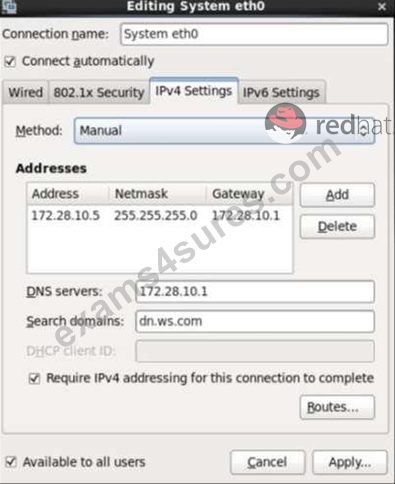
Note: Please remember to choose two options:
* Connect automatically
* Available to all users
Click "Apply", save and exit, and restart your network services:
# Service network restart
3. Validate these profiles:
a) Check gateway: # vim / etc / sysconfig / network
NETWORKING=yes
HOSTNAME=dtop5.dn.ws.com
GATEWAY=172.28.10.1
b) Check Host Name: # vim /etc/hosts
c) Check DNS: # vim /etc/resolv.conf
# Generated by NetworkManager
Search dn.ws.com
Nameserver 172.28.10.1
d) Check Gateway: # vim /etc/sysconfig/network-scripts/ifcfg-eth0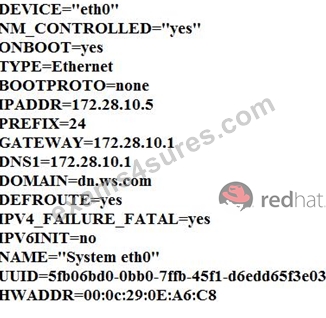
NEW QUESTION 77
Configure a HTTP server, which can be accessed through http://station.domain40.example.com.
Please download the released page from http://ip/dir/example.html.
Answer:
Explanation:
Answer see in the explanation.
Explanation/Reference:
# yum install -y httpd
# chkconfig httpd on
# cd /var/www/html
# wget http://ip/dir/example.html
# cp example.com index.html
# vim /etc/httpd/conf/httpd.conf
NameVirtualHost 192.168.0.254:80
<VirtualHost 192.168.0.254:80>
DocumentRoot /var/www/html/
ServerName station.domain40.example.com
</VirtualHost>
NEW QUESTION 78
Locate all the files owned by ira and copy them to the / root/findresults directory.
Answer:
Explanation:
see explanation below.
Explanation
# find / -user ira > /root/findresults (if /root/findfiles is a file)
# mkdir -p /root/findresults
# find / -user ira -exec cp -a {} /root/findresults\; [ if /root/findfiles is a directory] ls /root/findresults
NEW QUESTION 79
......
Books and Study Guides
While Red Hat offers training courses, there is always an option of independent preparation. Previous practical experience is always a plus but you can improve your chances of success with the help of books and study guides you can find on the Amazon website.
- Red Hat RHCSA 8 Cert Guide: EX200 (Certification Guide) 1st Edition by Sander van Vugt is the best selling book covering all exam topics and making you 100% ready for EX200 exam. Enhanced by end-of-chapter quizzes and four original practice tests, this study guide will walk you through the whole preparation process through comprehensive explanations. The final chapter will provide you with the tools and hints needed for success in the test. Besides, the Companion Website offers two free, complete practice exams and two full hours of video training.
- RHCSA Red Hat Enterprise Linux 8 (UPDATED): Training and Exam Preparation Guide (EX200), Second Edition Paperback by Asghar Ghori will prove helpful with its 23 logically structured chapters, covering the objectives of the RHCSA certification exam. The book is focused on giving you the most valuable test-related information and check your progress with review questions as well as Do-It-Yourself challenge labs. The contents are presented in the form of tables, screenshots, examples, and notes to make your studies fast and fruitful. The exam tips are there to give your insights on what to expect while taking the test.
- Latest Red Hat Certified System Administrator (EX200) Exam questions and answers: Redhat EX200 workbook by Eloic Dumps (Kindle Edition) is a fast way to hone your skills and identify any knowledge gaps. The questions and answers are regularly refreshed to make sure you get the most relevant information to help you do well in EX200 test. The topics and patterns are comparable to real-life experience for you to pass the exam at the first attempt and get the certification you need.
Latest EX200 Exam Dumps RedHat Exam from Training: https://www.exams4sures.com/RedHat/EX200-practice-exam-dumps.html
Newly Released EX200 Dumps for RHCSA Certified: https://drive.google.com/open?id=1GpGHDaD2vsiKNKtDQlr2cjM4x7ifiS4O