

[May-2024] Get 100% Real Free Aruba Certified Professional HPE7-A07 Sample Questions
Accurate HPE7-A07 Questions with Free and Fast Updates
NEW QUESTION # 22
A customer has interfering devices that are seen over the air. They contact you and ask you to configure RAPIDS to help identify interfering and rogue APs. HPE Aruba Networking Central identifies a rogue AP and displays the connected switch port.
How can HPE Aruba Networking Central identify which switch port the AP is connected to?
- A. from the switch LLDP neighbors table
- B. from the AP MAC address table
- C. device profiting on the switch
- D. from the switch MAC address table
Answer: D
Explanation:
HPE Aruba Networking Central can identify which switch port a rogue AP is connected to by using the switch's MAC address table. The MAC address table contains the associations between MAC addresses and the switch ports to which devices (including APs) are connected. When Aruba Central detects a rogue AP, it can look up the MAC address of the rogue AP in the switch's MAC address table to find the specific switch port it is connected to. This enables network administrators to quickly locate and address the rogue AP issue.
NEW QUESTION # 23
The ACME company has an AOS-CX 6200 switch stack with an uplink oversubscription ratio of 9.6:1. They are considering adding two more nodes to the stack without adding any additional uplinks due to cabling constraints One oftheir architects has expressed concerns that their critical UDP traffic from both wired and bridged AP clients will encounter packet drops.They have already applied the following configuration:

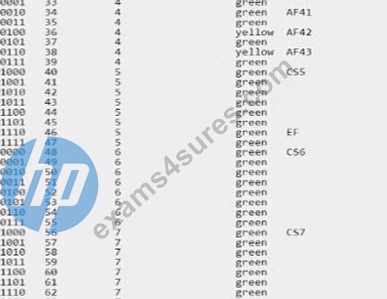
Which strategy will complement this solution to achieve their objective?
- A. edge mark lower priority TCP traffic with AF12
- B. edge mark critical UDP traffic with AF42
- C. edge mark lower priority TCP traffic with AF11
- D. edge mark critical UDP Traffic with CSS
Answer: B
Explanation:
Given that the ACME company's concern is about UDP traffic potentially encountering packet drops due to uplink oversubscription, they need a strategy that prioritizes critical UDP traffic to minimize loss.
Option D,edge mark critical UDP traffic with AF42, is the correct answer. Assured Forwarding (AF) classes provide a way to assign different levels of delivery assurance for IP packets. AF42 is typically used for traffic that requires low latency and low loss, such as voice and video, which often use UDP. Marking critical UDP traffic with AF42 will help ensure that this traffic is treated with higher priority over the network.
Option A (edge mark lower priority TCP traffic with AF12) and Option C (edge mark lower priority TCP traffic with AF11) suggest marking lower priority TCP traffic, which does not directly address the concern for critical UDP traffic.
Option B (edge mark critical UDP Traffic with CS5) suggests using Class Selector 5 for critical UDP traffic, which is also a valid approach but does not match the existing configuration that is focused on Assured Forwarding (AF) classes.
NEW QUESTION # 24
You want to configure an MTU of 9198 for a routedlag interface on a CX 6300 switch.Which configuration achieves this?
- A.

- B.

- C.

- D.

Answer: A
Explanation:
In the context of ArubaOS-CX, particularly with the 6300 series switches, setting the MTU on a routed Link Aggregation Group (LAG) interface requires theinterface lag idcommand in the configuration, specifying the LAG interface you're configuring. Theip mtucommand is then used to set the desired MTU size for that LAG.
Option A correctly shows this configuration process, where the MTU is set to 9198 for the LAG interface, in line with the requirements for routing larger frames, which could be necessary for certain applications or data flows that require jumbo frames.
The information related to the configuration of Aruba switches is consistent with the principles and guidelines found in the technical documentation for the ArubaOS-CX 6300 series switches, which emphasizes the importance of correct MTU settings for network performance and stability.
NEW QUESTION # 25
You are deploying a new AOS 10 mobility gateway cluster. Due to customer requirements, the gateways must be configured with static IP addresses and are restricted from communicating using port 443 to any URLs except tor "central arubanetworks.com How would you onboard these gateways successfully into HPE Aruba Networking Central?
- A.

- B.

- C.

- D.

Answer: D
Explanation:
Option A includes all necessary steps for a full setup of an AOS 10 mobility gateway cluster, including setting the system name, switch role, ACP FQDN address, uplink port information, IP address and default gateway, DNS IP address, controller country code, timezone and clock, andadmin password. Since the gateways must have static IP addresses and can only communicate on port 443 for a specific URL, this configuration would need to allow for static IP configuration and restrict communication to the required URL.
NEW QUESTION # 26
Exhibit.
An engineer has applied the above configuration to R1 and R2 However the routers OSPF adjacency never progresses past the "EXSTART-DR" slate as shown below.
Which configuration action on either router will allow R1 and R2 to progress past the "EXSTART/DR" state?
- A. Change the IP address and mask applied to interface 1/1/1.
- B. Ensure the OSPF process is not configured with passive-interface default.
- C. Change R1 and R2 to a network type of point-to-point.
- D. Remove the layer 3 MTU configuration.
Answer: C
Explanation:
In OSPF, the "EXSTART/DR" state indicates that the routers are trying to establish an adjacency but are unable to progress. This can happen if the OSPF network type is incorrectly configured for the type of connection between the routers. Given that R1 and R2 are connected via a point-to-point link (as suggested by the /31 subnet), setting the network type to point-to-point on both routers will remove the need for DR/BDR election, which is unnecessary on a point-to-point link, and allow OSPF to progress past the "EXSTART" state and form a full adjacency.
NEW QUESTION # 27
Which statement is true given the following CLIoutput from a CX 6300?
- A. There are two anycast addresses m me overlay fabric.
- B. The underlay loopback addresses are in the 172 21 11 x range.
- C. Duplicate MAC addresses were detected in the overlay fabric
- D. There are three active client overlay VLANs in the overlay fabric
Answer: B
Explanation:
The CLI output displays EVPN routes and their corresponding next hops. The "Route Distinguisher" entries followed by IP addresses in the 172.21.11.x range indicate these are loopback addresses used by the underlay network. The underlay network provides the basic routing and forwarding plane for the overlay network that EVPN is part of. These loopback addresses are crucial for the proper functioning of the EVPN control plane.
NEW QUESTION # 28
A network technician racked up two 9240 mobility gateways in a single cluster that will be terminating 1700 APs in a medium-sized branch office Next, the technician cabled the gateways with two SFP28 Direct Attach Copper (DAC) cables, distributed between a two-member core switching stack and powered them up.
What must the network administrator do next regarding the gateway configuration to ensure maximum wired bandwidth utilization?
- A. Manually set 25Gbps speeds on all ports.
- B. Make an ports trunk interfaces and permit data VLANs
- C. Disable the spanning tree and allocate unique VLANs to each port.
- D. Map two physical ports to a port channel on each gateway.
Answer: D
Explanation:
To maximize wired bandwidth utilization, especially when multiple APs are terminating on mobility gateways, it's best practice to aggregate physical ports into a port channel. This provides redundancy and increased bandwidth by combining the throughput of multiple ports.
NEW QUESTION # 29
You created a new SSID with the security settings shown in the exhibit.
Some, but not all users complain that client devices are unable to connect to this SS1D. What is the reason for this?
- A. The WPA3 Enterprise GCM-2S6 mode does not support transition mode.
- B. WPA3 Enterprise is not backward compatible with WPA2 Enterprise.
- C. The primary servers shared key differs from the shared key configured for this server on HPE Aruba Networking Central.
- D. MAC authentication after a failed 802. ix authentication is not possible as the option "MAC Authentication Fall-Through" is disabled.
Answer: D
Explanation:
If some users are unable to connect to an SSID configured with WPA3-Enterprise GCM-256, and the "MAC Authentication Fall-Through" is disabled, it means that devices which fail 802.1X authentication will not attempt MAC authentication. If these client devices are configured to use MAC authentication as a backup method, they will fail to connect, explaining the issue faced by some users.
NEW QUESTION # 30
A deployment using AP-635S is connectedto a stack of CX 6300s as shown.
The output of the snow LACPinterfaces shews the following:
What is causing this issue?
- A. Spanning tree and loop protect are enabled on both AP uplink ports.
- B. The AP is configured with LACP active
- C. e0 is connected to a smart rate interface, and e1 is connected to a non-smart rate interface.
- D. Each AP interface is connected to a routed-only interlace on different networks
Answer: B
Explanation:
In an Aruba deployment, if an AP's interfaces show different LACP states, it often indicates a configuration mismatch. If one interface is up and the other is blocked as shown in the output,it's likely due to both interfaces on the AP being set to LACP active mode, which is a correct setting for establishing an LACP channel with Aruba switches like the CX 6300 series.
NEW QUESTION # 31
Which command would allow you to verity receipt of a CoA message on an AOS 10 GW?
- A. tcpdump host-port 3799
- B. packet-capture datapath udp 3799
- C. packet-capture controipath udp 3799
- D. packet-capture interprocess udp 3799
Answer: C
Explanation:
The Change of Authorization (CoA) messages are used in network access control scenarios and are typically received by the network access server, in this case, an Aruba AOS 10 Gateway. The correct command to verify the receipt of a CoA message is related to the control path traffic because CoA is a control plane function.
Option B,packet-capture controlpath udp 3799, is the correct answer because it specifies capturing control plane traffic on UDP port 3799, which is the standard port for CoA messages.
Options A, C, and D are incorrect because:
Option A captures data plane traffic, not control plane traffic.
Option C'spacket-capture interprocess udp 3799does not refer to a standard command for capturing CoA messages.
Option D,tcpdump host-port 3799, does not specify the correct syntax for capturing traffic on Aruba devices.
NEW QUESTION # 32
Exhibit.

After configuring VRRP between sw-1 and SW-2. you notice that both switches are showing as active. What could be the reason for this issue?
- A. SW-2 has no priority configurations for VRRP 1.
- B. Both switches are configured as VRRP 'primary.'
- C. VRRP preemptive mode is disabled.
- D. SW-1 cam reach SW-2 on VLAN 10.
Answer: B
Explanation:
In VRRP (Virtual Router Redundancy Protocol), only one switch should be the primary (master) for a given virtual IP address, with the other switches being backups. If both switches are showing as active, it suggests a misconfiguration where both are set to act as the primary for the same VRRP group. The exhibits provided indicate that both switches believe they are the active or primary for the VRRP group, which is an incorrect configuration.
NEW QUESTION # 33
You configured a tunneled SSID with captive portal and a ClearPass Guest Self Registration workflow when testing and launching the self-registration workflow, after successful registration, the login action shows the following error:
What is the best solution to resolve this error?
- A. You need to De connected to the guest SSiD while testing.
- B. You need to change the Login Address in ClearPass to securelogin arubanetworKs.com
- C. You need to include the root and intermediate certificates in the captive portal certificate for your gateway
- D. You need to include the root and intermediate certificates in the captive portal certificate for your access points
Answer: C
Explanation:
Including the root and intermediate certificates in the captive portal certificate for the gateway will resolve the error seen during the login action after successful registration. This is necessary to ensure the SSL/TLS handshake can be completed successfully, as the client browser needs to validate the entire certificate chain.
NEW QUESTION # 34
An AOS 10 multi-site deployment has sites with AP-only bridged SSlDs and other sites with APs and gateways operating tunneled SSiDs. Client session state sync errors exist between secure lab environments and public -facing areas at several sites.
What is causing the issues?
- A. The affected clients are associated with an SSID with 11r and 11k disabled.
- B. The sites with issues are the AP-only deployments because the connection to HPE Aruba Networking Central is interrupted
- C. The DTLS connections are down between APs in the lab and APs in public areas
- D. The sites with issues are the overlay AP with gateway sites because the connection to HPE Aruba Networking central is interrupted
Answer: D
Explanation:
In a multi-site deployment with a mix of bridged and tunneled SSIDs, if there are session sync errors between different areas, it could be due to connectivity issues with the central management platform, which in the case of Aruba, is likely HPE Aruba Networking Central. This interruption could cause inconsistencies in session states across the network.
NEW QUESTION # 35
The ACME company has an AOS-CX 6200 VSF switch slack with an uplink over subscription ratio of 9.6:1.
They have indicated that their low-priority TCP traffic has been flagged with a DSCP marking coloring them yellow.
Refer to the exhibit.

They are considering adding two more nodes to thestack without adding any additional uplinks due to existing wiring constraints.One of their architects has suggested adding the following configuration:
What would be the impact of applying the acmethreshold profile as shown? (Select two.)
- A. All upper-layer protocol traffic egressing LAG1 will be subject to drop probability.
- B. Only VoIP packets egressing queue 5 on LAG1 will likely be protected from uplink over-utilization.
- C. VoIP packets egressing any queue on LAG1 will more likely be protected from uplink over-utilization
- D. Yellow-flagged TCP traffic egressing LAG1 will be subject to drop probability
- E. All TCP traffic egressing LAG1 wail be subject to drop probability
Answer: A,D
Explanation:
Applying the 'acmethreshold' profile as shown in the exhibit would set a minimum and maximum threshold for queue 0, which affects the drop probability for traffic that exceeds these thresholds. The yellow marking indicates a medium drop precedence, so yellow-flagged traffic would be more likely to be dropped when congestion occurs, and the uplink is over-utilized. This action is intended to protect higher-priority traffic, such as VoIP, by giving it a lower probability of being dropped.
NEW QUESTION # 36
Exhibit.
Which statement is true?
- A. The SSID supports 802 11ax clients.
- B. The SSID supports 802 11ac clients.
- C. The SSID is supports 6 GHz clients.
- D. The SSID supports HR-DSSS data rates
Answer: A
Explanation:
The exhibit shows that the SSID supports 802.11ax clients, which is indicated by the presence of HT (High Throughput) information, VHT (Very High Throughput) capabilities, and HE (High-Efficiency) operation, which are all features associated with 802.11ax, also known as Wi-Fi 6.
NEW QUESTION # 37
Exhibit.
A university runs its own TV station in the city The IT department deploys a multimedia server so the TV productions can be sent out to the entire campus over the IP network using multicast-based communications in order to improve the bandwidth consumption. PlM sparse Mode and IGMP snooping features are enabled.
When wireless users join the multicast groups, all users connected to the same WLAN experience poor network performance. However, wired users are not affected in this way While troubleshooting the network administrator saves the packet captures shown in the exhibit and concludes that all users even those not joining the multicast group, receive the same multicast flow at slow speeds.
Which features should the network administrator enable to fix the problem?
- A. UCC QoS correction and Multicast Transmission Optimization
- B. Dynamic Multicast Optimization and Multicast Transmission Optimization
- C. Dynamic Multicast Optimization and UCC QoS correction
- D. ARP broadcast conversion into unicast and Multicast Transmission Optimization
Answer: B
Explanation:
Dynamic Multicast Optimization (DMO) and Multicast Transmission Optimization are features that can help address issues with multicast traffic in wireless environments. DMO optimizes the way multicast traffic is transmitted over the air by converting multicast streams into unicast streams to the clients that need them. This reduces unnecessary traffic for clients that have not subscribed to the multicast group and can improve overall network performance. Multicast Transmission Optimization adjusts the transmission rate of multicast frames to ensure they are sent at optimal speeds, addressing the issue of multicast flow being received at slow speeds by all users.
NEW QUESTION # 38
An ACME company employee complained about a recent poor-quality VoIP call while moving aroundtheir office environment HPE Aruba Networking Central reported a fair UCC score for this callwhile your VoIP engineer reported that their systems reported a MOS of 2,3. The VoIP devices are operatingover the 5GHz frequency band.
What are the possible contributing factors? (Select two.)
- A. 802.1K is disabled in the WLAN Security settings
- B. 802.tr is enabled in the WLAN Security settings.
- C. There was localized interference at the caller's location
- D. Coverage AP deployment plans generally don't support enough cell overlap for VoIP.
- E. The client roamed into an area that continuously operates Zigbee.
Answer: D,E
Explanation:
VoIP quality can be negatively impacted by insufficient cell overlap in AP deployment plans, which can cause poor handoffs between APs as a user moves around. This results in a degraded VoIP experience. Additionally, roaming into an area with continuous Zigbee operation can cause interference with the 5GHz frequency band, further contributing to poor VoIP call quality. The Zigbee communication protocol operates on the same frequency band as Wi-Fi and can introduce noise and interference, which leads to a reduced MOS score, as reported by the VoIP engineer.
NEW QUESTION # 39
A university owns a campus with several buildings segmented into east and west wings, which are L3 separated. The east wing has 1600 APs. and the west wing has 1200 Aps. Each wing has a single gateway cluster managed by HPE Aruba Networking Central. Each cluster contains one 7210 mobility gateway The gateways are configured with DHCP relay and route all client VLANs. A new business-critical facultyreal-time application requires users to roam within wings but not across wings without disconnections or delay increments.
Which changes must the network administrator make lo successfully meet the requirement without performance degradation matching best practices? (Select two.)
- A. Remove the DHCP relay from the gateways and enable the DHCP server instead
- B. Replace me 7210 mobility gateway in the east wing with a pair or 9012 mobility gateways
- C. Add a single 7210 mobility gateway to each cluster.
- D. Run L2 for all SSIDs and permit the users' VLANs in the gateway's uplinks.
- E. Replace the 7210 mobility gateway in the west wing with a pair of 7030 mobility gateways.
Answer: C,D
Explanation:
To support a business-critical faculty real-time application that requires seamless roaming within wings without cross-wing roaming, it's essential to ensure high availability and sufficient capacity. Adding an additional 7210 mobility gateway to each cluster would provide the required redundancy and capacity.
Running L2 for all SSIDs and permitting user VLANs on gateway uplinks would facilitate the necessary traffic flow without L3 segmentation issues, thus supporting seamless roaming within each wing.
NEW QUESTION # 40
Which data transmission method provides the most efficient use of airtime for VoIP traffic?
- A. MU-MIMO
- B. OFDM
- C. FDMA
- D. TWT
Answer: A
Explanation:
MU-MIMO (Multi-User, Multiple Input, Multiple Output) provides the most efficient use of airtime for VoIP traffic among the options listed. MU-MIMO allows multiple users to receive multiple data streams simultaneously, improving the overall efficiency of the network, especially in dense environments where VoIP applications need consistent and reliable connectivity.
NEW QUESTION # 41
Exhibit.
Which user role will be assigned when a voice client tries to connect for the first time, but the RADIUS server is unavailable?
- A. CRIT1CAL_V0ICE
- B. PRE_AUTH
- C. CRITICAl_AUTH
- D. DEFAULT_AUTH
Answer: A
Explanation:
In the provided configuration for interface 1/1/7, there are roles specified for different scenarios concerning authentication. When a voice client attempts to connect and the RADIUS server is unreachable, the role that is assigned is the one specified as the "critical-voice-role". In this case, the "CRITICAL_VOICE" role is configured to be assigned under such circumstances, ensuring that voice clients receive appropriate network access permissions even when the RADIUS server is not available to authenticate them.
NEW QUESTION # 42
A customer is running out of IP addresses in a network segment. What will happen If they add an additional IPsubnet to the same VLAN?
- A. This would result in a single SVI using two subinterfaces.
- B. Broadcasts for me two subnets win arrive on all ports in the same VLAN
- C. Users can reach each other and establish PTP traffic without passing an L3 point in the same VLAN
- D. IGMP will not work in both of the subnets in the same VLAN
Answer: C
Explanation:
Adding an additional IP subnet to the same VLAN means that devices configured with either subnet can communicate at Layer 2 without the need for routing. This is because they are on the same VLAN and thus in the same broadcast domain. However, to communicate between subnets, an L3 device or inter-VLAN routing would be required.
NEW QUESTION # 43
Based on best practices if an SSID is configured Tor a primary and secondary gateway cluster with cluster preemption enabled, which will decide if the APs move to the secondary gateway cluster if all of the nodes in the primary gateway cluster are down?
- A. tunnel orchestrator for LAN tunnel service in HPE Aruba Networking Central
- B. cluster leader in the primary gateway cluster
- C. every AP individually
- D. cluster leader in the secondary gateway cluster
Answer: C
Explanation:
In an Aruba network, if an SSID is configured for a primary and secondary gateway cluster with cluster preemption enabled, each AP individually will decide to move to the secondary gateway cluster if all of the nodes in the primary gateway cluster are down. This decentralized decision-making process enhances network resilience and ensures uninterrupted service for clients connected to the APs.
NEW QUESTION # 44
A customer's infrastructure is set up to use Doth primary and secondary gateway clusters on the SSID profile What is a valid reason for the AP to failover to the secondary gateway cluster?
- A. The secondary gateway cluster is homogeneous.
- B. The primary gateway cluster is up. out the AP is unable to reach the primary gateway cluster.
- C. The secondary gateway cluster is up. hut the AP is unable to reach the secondary gateway cluster
- D. The secondary gateway cluster is heterogeneous.
Answer: B
Explanation:
In Aruba's infrastructure, the Access Points (APs) are configured with primary and secondary gateway clusters to ensure connectivity and resiliency. The APs will failover to the secondary gateway cluster if they are unable to reach the primary gateway cluster, even if the primary cluster is operational. This mechanism ensures that the APs maintain connectivity to the network infrastructure for continuous service delivery.
NEW QUESTION # 45
Which statements accurately describe OSPF Graceful Restart (when the restarting router is able to Keep its forwarding tables across the restart)? (Select two.)
- A. You must ensure your VSF stack has a secondary member when acting as a GR helper
- B. VSF Failover and Graceful-Restart require a VSF secondary member in the VSF stack
- C. OSPF Routers listen for Grace-LSAs on each network segment where there is an OSFP adjacency.
- D. Bidirectional Forwarding Detection for OSPF and GR are mutually exclusive features.
- E. The GR helper role is supported on AOX-CX 6100 switches.
Answer: C,E
Explanation:
Graceful Restart (GR) allows a router to continue forwarding packets while it restarts its OSPF process. The GR helper role on AOS-CX switches supports routers during this process. OSPFrouters listen for Grace-LSAs to identify neighbors undergoing a graceful restart, maintaining adjacencies with those routers to allow uninterrupted forwarding.
NEW QUESTION # 46
Exhibit.
Which would explain this issue?
- A. ".aruba-training com needs to be entered in the Address field for the ClearPass Guest
- B. captiveportal-login aruba-training com needs to be entered m the Address field for the ClearPass Guest
- C. HTTPS certificate is not required in ClearPass Guest.
- D. HTTPS wildcard certificates are not supported
Answer: A
Explanation:
The correct address for the ClearPass Guest should match the FQDN of the HTTPS certificate installed on the device, which is often the FQDN of the vendor's product. This ensures secureand proper redirection to the captive portal during the authentication process. The FQDN should be entered in the Address field for ClearPass Guest configuration.
NEW QUESTION # 47
......
HPE7-A07 Study Guide Realistic Verified Dumps: https://www.exams4sures.com/HP/HPE7-A07-practice-exam-dumps.html
Self-Study Guide for Becoming an Aruba Certified Campus Access Mobility Expert Written Exam Expert: https://drive.google.com/open?id=1KL_VQkH8nZB3bybBvmSKKGRROeNQKWa7